$185.99
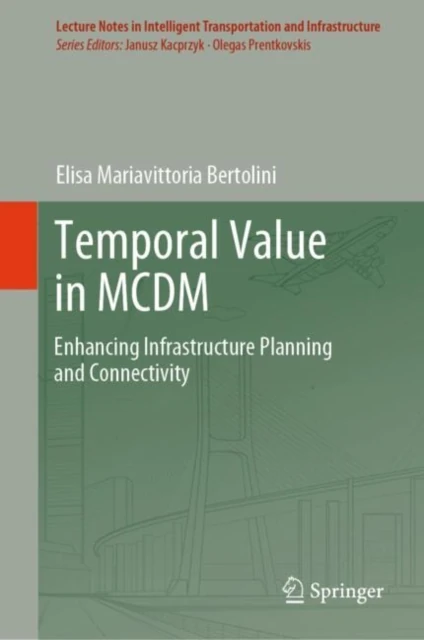
Temporal Value in MCDM
Enhancing Infrastructure Planning and Connectivity

Overview of the Transportation Planning Process
This book outlines a process for planning transportation systems, employing qualitative methods to explore the balance between various considerations, and highlighting power asymmetries among key stakeholders. It serves as a decision support tool, complementing the usual techniques used in multi-criteria analysis (MCA). The book delves into the dynamics of territorial governance within a group decision-making context.
Decision Support and Methodology
The proposed tool provides a rational approach to addressing the main challenges that arise in the territorial context, promoting greater consensus among all parties involved in the decision-making process. The methodology allows for a deep appreciation of the contribution of decision analysis frameworks in the territorial scenario, particularly in group decision-making settings, where the literature on participatory MCA is rather sparse.
Stakeholder Analysis
To achieve a practical synthesis of the stakeholders' positions and to enrich the multi-criteria framework, the book introduces a tool for systematic analysis of stakeholder behaviour. Without this tool, the MCA analysis would be incomplete for providing adequate decision support.
Multi-Criteria Techniques
The multi-criteria techniques underpinning the analysis, such as the Simple Additive Weighting (SAW), simplified Simos method, and the MACTOR case-based method, facilitate the identification of strategic directions based on criteria and parameters reflective of the relevant territorial framework.
Evaluation Over Time
This outcome was achieved through successive evaluations of increasing complexity. Initially, the performances over short, medium, and long-term periods were considered separately, based on the alternatives and criteria identified by the stakeholders, including both economic and welfare aspects. Subsequently, a method was developed to coherently compare the performances of various alternatives over different timescales, aggregating the values into a single measure while also accounting for the duration of effects across these periods.
Temporal Significance in Decision-Making
This approach leads to a greater awareness of the temporal significance of decisions, understanding how impacts vary over time and how these should be carefully assessed. This understanding helps overcome the difficulties associated with balancing long-term visions with immediate needs. As evidenced by the results, considering the time factor in evaluations alters both the values and, in some cases, the aggregated outcomes in the Alternatives/Stakeholders matrices. This highlights the necessity of incorporating temporal preference elicitation into the MCA model to accurately reflect their influence on decision-making.