$199.99
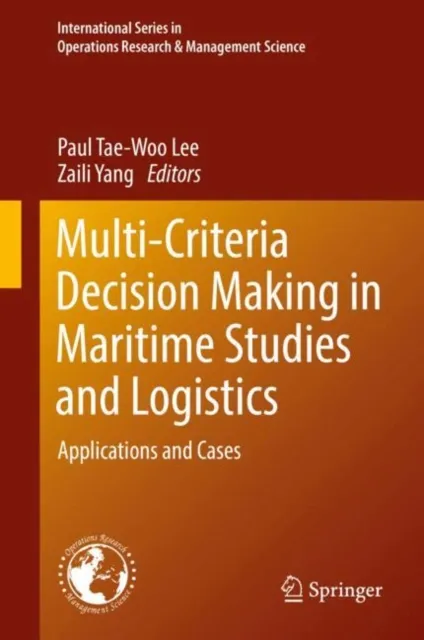
Multi-Criteria Decision Making in Maritime Studies and Logistics
Applications and Cases

Introduction and Overview
This book describes a wide range real-case applications of Multi-Criteria Decision Making (MCDM) in maritime related subjects including shipping, port, maritime logistics, cruise ports, waterfront developments, and shipping finance, etc. In such areas, researchers, students and industrialists, in general, felt struggling to find a step-by-step guide on how to apply MCDM to formulate effective solutions to solving real problems in practice. This book focuses on the in-depth analysis and applications of the most well-known MDCM methodologies in the aforementioned areas. It brings together an eclectic collection of twelve chapters which seek to respond to these challenges. The book begins with an introduction and is followed by an overview of major MCDM techniques.
Analytic Hierarchy Process and Fuzzy AHP
The next chapter examines the theory of analytic hierarchy process (AHP) in detail and investigates a fuzzy AHP (FAHP) approach and its capability and rationale in dealing with decision problems of ambiguous information.
Green Shipping Evaluation
Chapter 4 proposes a generic methodology to identify the key factors influencing green shipping and to establish an evaluation system for the assessment of shipping greenness.
Fuzzy Evidential Reasoning in Vessel Selection
In Chapter 5, the authors describe a new function of fuzzy Evidential Reasoning (ER) to improve the vessel selection process in which multiple criteria with insufficient and ambiguous information are evaluated and synthesized.
Collision Probability Estimation
Chapter 6 presents a novel methodology by using an Artificial Potential Field (APF) model and the ER approach to estimate the collision probabilities of monitoring targets for coastal radar surveillance.
Inland Port Performance Assessment
Chapter 7 develops the inland port performance assessment model (IPPAM) using a hybrid of AHP, ER and a utility function.
Risk and Uncertainty in LNG Transfer Operations
The next chapter showcases a challenging approach to address the risk and uncertainty in LNG transfer operations, by utilizing a Stochastic Utility Additives (UTA) method with the help of the philosophy of aggregation–disaggregation coupled with a robustness control procedure.
Financial Ratio Analysis
Chapter 9 uses Entropy and Grey Relation Analysis (GRA) to analyze the relative weights of financial ratios through the case studies of the four major shipping companies in Korea and Taiwan: Evergreen, Yang Ming, Hanjin and Hyundai Merchant Marine.
Operation Optimization in Container Terminals
Chapter 10 systemically applies modern heuristics to solving MCDM problems in the fields of operation optimisation in container terminals.
Bunkering Port Selection and Decision Making
Arguing that bunkering port selection is typically a multi-criteria group decision problem, and in many practical situations, decision makers cannot form proper judgments using incomplete and uncertain information in an environment with exact and crisp values, in Chapter 11, the authors propose a hybrid Fuzzy-Delphi-TOPSIS based methodology with a sensitivity analysis.
Port Performance Indicators
Finally, Chapter 12 deals with a new conceptual port performance indicators (PPIs) interdependency model using a hybrid approach of a fuzzy logic based evidential reasoning (FER) and a decision making trial and evaluation laboratory (DEMATEL).