$59.99
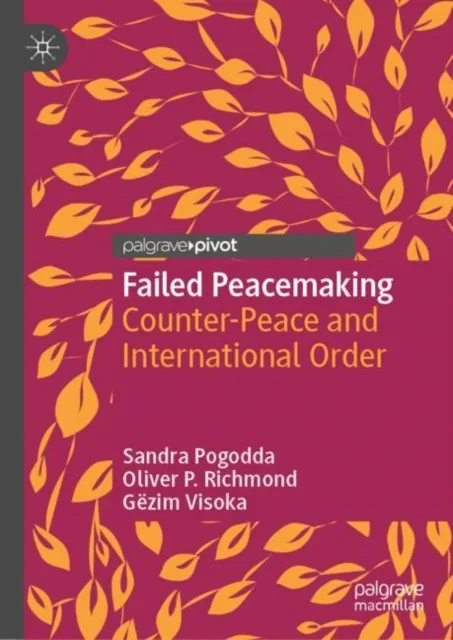
Failed Peacemaking
Counter-Peace and International Order

Introduction
This book investigates why peace and reform processes across the world have recently been stagnating or have become blocked. They have failed to maintain security, rights, development, and justice in the liberal international order. The book identifies the related rise of counter-peace processes at the heart of failed peacemaking efforts, and explores the implications for an emerging multi-polar order where local and international tools for peace and reform appear to be ineffective. Across a range of recent cases, from Cambodia, the Balkans, the Sahel region, DRC, Colombia, Afghanistan, and many others, such dynamics are becoming clearer. In particular, small-scale blocking tactics across different peace processes have been evolving into larger political strategies which are then disseminated within revisionist and revanchist international networks. Ultimately, this phenomenon has undermined liberal international order.
Spoilers and tactical blockages to peace have connected across local, national, regional and international scales, highlighting ideological divisions. Drawing on counter-revolutionary theory, the concept of counter-peace is used as a tool to critically interrogate a systemic array of blockages to peace. Distinct counter-peace patterns are now entangled in peace and reform processes, including the stalemate pattern, the limited counter-peace, and the unmitigated counter-peace patterns. Across cases, once tactical blockages begin to form these patterns, they become systemic and ultimately enable conflict escalation. Consequently, the intimate entanglement of the existing international peace architecture with counter-peace processes points to ideological divisions in international order, as well as the growing gulf between diminished practices of peace and reform with critical scholarship on peace, justice, and sustainability.