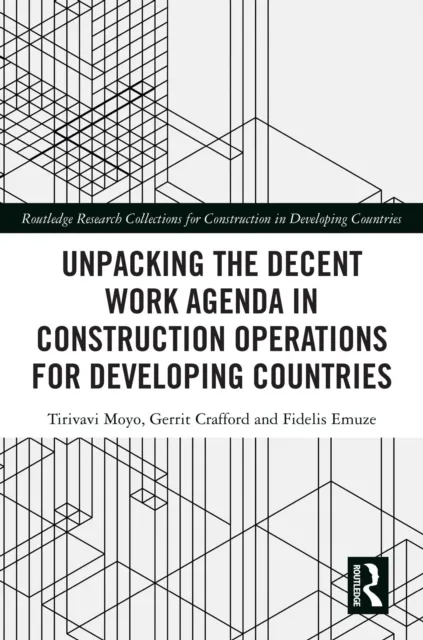
Unpacking the Decent Work Agenda in Construction Operations for Developing Countries

$74.99
Taxes may apply at checkout.

Unpacking the Decent Work Agenda in Construction Operations for Developing Countries

Sociology: work and labour Business ethics and social responsibility Construction and building industry

Authors: Tirivavi Moyo, Gerrit Crafford, Fidelis Emuze

Dinosaur mascot

Collection: Routledge Research Collections for Construction in Developing Countries

Language: English

Published by: Routledge

Published on: 7th June 2023

Format: LCP-protected ePub

ISBN: 9781000890990


Low construction labour productivity and the inadequate welfare of construction workers are consistent challenges in developing countries. These challenges are partially due to shortcomings situated in the Decent Work Agenda. This book proposes ways of sustaining construction labour productivity through fulfilling the Decent Work Agenda. This is a unique area of focus that is essential to fulfilling the broader and global aspects of decent work, sustainability and construction labour productivity. Also, the focus of this book is on contributing to the plight of construction workers whose treatment is significantly unsound.

The construction industry needs to develop a humanistic face and contribute to the UN’s sustainable development goal of achieving full and productive employment and decent work for all women and men. To achieve this, construction companies are encouraged to implement corporate social responsibility strategies by equipping workers of different educational levels with knowledge and skills that can be transferred to benefit themselves and their communities. Thus, establishing structured on-the-job training that incorporates sustainability-learning objectives to achieve workers’ safety on sites is essential.

The book advocates for decency in the workplace through people-centred management, sustainability learning of skilled and semi-skilled construction workers and decent working conditions. It will be of interest to construction industry policymakers, construction professionals, academics and students of sustainable development and developing economies.

Show moreShow less