$76.99
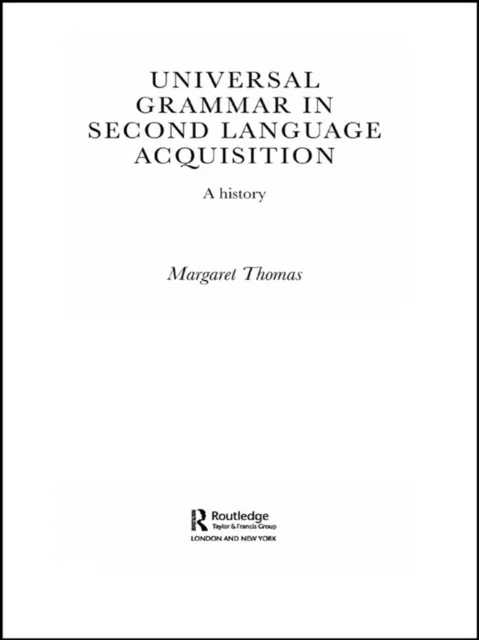
Universal Grammar in Second-Language Acquisition
A History

From the ancient Mediterranean world to the present day, our conceptions of what is universal in language have interacted with our experiences of language learning.
This book tells two stories: the story of how scholars in the west have conceived of the fact that human languages share important properties despite their obvious differences, and the story of how westerners have understood the nature of second or foreign language learning.
In narrating these two stories, the author argues that modern second language acquisition theory needs to reassess what counts as its own past. The book addresses Greek contributions to the prehistory of universal grammar, Roman bilingualism, the emergence of the first foreign language grammars in the early Middle Ages, and the Medieval speculative grammarians efforts to define the essentials of human language. The author shows how after the renaissance expanded people's awareness of language differences, scholars returned to the questions of universals in the context of second language learning, including in the 1660 Port-Royal grammar which Chomsky notoriously celebrated in Cartesian Linguistics. The book then looks at how Post-Saussurean European linguistics and American structuralism up to modern generative grammar have each differently conceived of universals and language learning.
Universal Grammar in Second Language Acquisition
is a remarkable contribution to the history of linguistics and will be essential reading for students and scholars of linguistics, specialists in second language acquisition and language teacher-educators.