$83.99
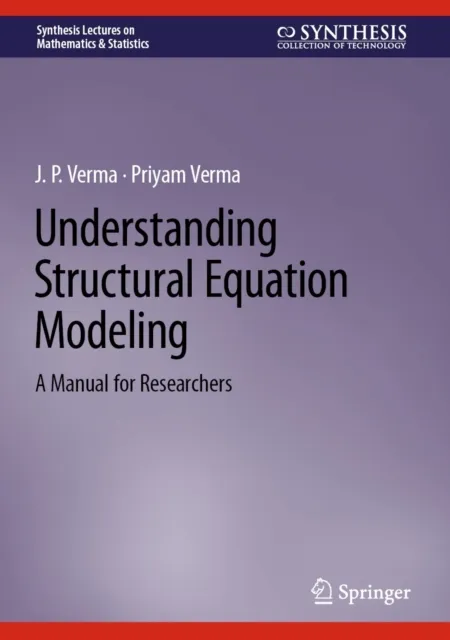
Understanding Structural Equation Models
Models of Relationships Between Variables

Challenges in Structural Equation Models (SEMs)
The field of structural equation models (SEMs) is rapidly expanding. A researcher who wants to select and apply SEMs to their data faces several challenges: (1) They can often become extremely complex, with many parameters to estimate. Small samples or those with relatively few variables often cannot support this complexity reliably, leading to under-identified models, poor power, or unstable estimates; (2) Researchers must choose an appropriate measurement model, and these choices are not often well understood in advance; (3) No single correct SEM exists, although better ones do, and the existence of competing plausible alternatives is often overlooked; and (4) Critical examination of model assumptions involving the linearity of parameters and the existence of influential or outlying observations is often overlooked.
Overview of SEMs
This book provides an overview of SEMs as a flexible, skeptical, and iterative scientific process.
Key Features
Emphasis on multiverse analysis, right-sizing statistical models to data, and the generation of plausible skeptical alternatives
Robust assumption checking (LOESS regression, regression and SEM diagnostics)
Detailed, visual coverage of a variety of path diagrams, their links to matrix-based specifications, and data exploration using heat-map visualization and tests of dimensionality
A variety of SEMs including mediational models, psychometrics (e.g., parallel, tau-equivalent, congeneric measurement), growth curve models, exploratory factor analysis, multigroup, categorical, and exploratory structural equation modeling
Supplemented by a website featuring code, data, lecture slides, and additional material
Intended Audience
This text is designed for graduate students, early-career researchers, and advanced undergraduates who wish to move beyond plug-and-play SEMs to a deeper, more philosophical and data-conscious understanding. Its careful balance of theory, worked examples, and emphasis on skepticism will help its audience build confidence in using SEMs flexibly and responsibly for a broad range of social and behavioral science research.