$114.99
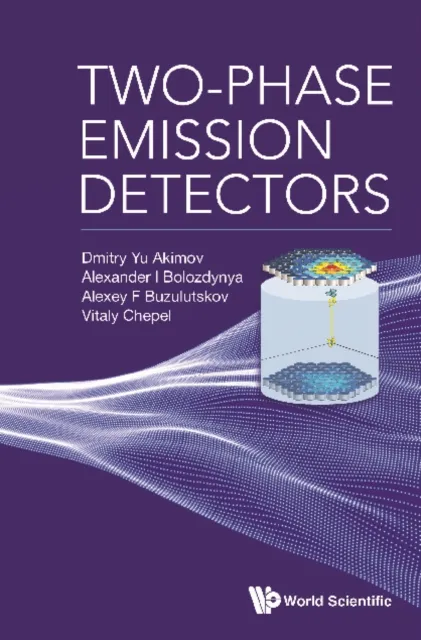
Two-phase Emission Detectors

Introduction to Non-Accelerator Experiments in Modern Nuclear Physics
One of the rapidly developing areas of modern experimental nuclear physics is non-accelerator experiments using low-background detectors. Such experiments, as a rule, are aimed at solving problems that are of fundamental importance for understanding the structure of the Universe, checking the Standard Model of elementary particles, and looking for new physics behind the observable world.
The most interesting tasks include the search for dark matter in the form of new weakly interacting particles, the search for neutrinoless double beta decay, the determination of the magnetic moment of the neutrino, the study of neutrino oscillation and new types of interaction of elementary particles, such as coherent neutrino scattering off heavy nuclei.
All these processes, occurring with extremely low cross sections, require the development of efficient large-mass detectors capable of detecting small energy releases down to individual ionization electrons. An effective method to do this is the emission method of detecting ionizing particles in two-phase media, which has been proposed at Moscow Engineering Physics Institute (MEPhI) 50 years ago.
Historical Background and Development of Emission Detectors
The origin of this technique can be traced to the research headed by Prof. Boris A Dolgoshein, whose study focus on the properties of condensed noble gases as a means to develop a tracking streamer chamber with a high-density working medium.
Focus of the Monograph
This monograph, devoted exclusively to two-phase emission detectors, considers the technology's basic features while taking into account new developments introduced into experimental practice in the last ten years since the publication of its predecessor, Emission Detectors (Bolozdynya, 2010).