$38.99
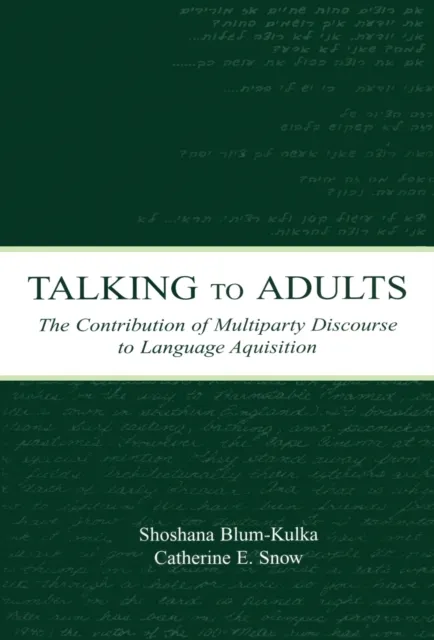
Talking to Adults
The Contribution of Multiparty Discourse to Language Acquisition

This volume provides a comprehensive and in-depth analysis of the contribution of multiparty intergenerational talk in a variety of cultures to the development of children''s communicative capacities. The book focuses on the complexity of the cultural and interactional contexts in which pragmatic learning occurs and re-examines certain assumptions implicit in research on language socialization to date, such as primacy of dyadic interactions in the early ages and the presupposition of a monolingual social matrix.
One of the aims of the book is to demonstrate the degree of cultural diversity in paths of pragmatic development. Individual chapters present empirically grounded analyses of talk with children of all ages, in different participation structures and in a variety of cultures. In pursuing this theme the volume is meant to further enrich cross-cultural perspectives on language socialization by providing in each of its chapters an empirically grounded analysis of the development of one specific dimension of discursive skill.
The nine invited chapters comprise new empirical work on the development of specific discourse dimensions. Authors have been asked also to adopt a reflexive stand on their line of research and to incorporate in the chapter a comprehensive and critical perspective on former work on the discursive dimension investigated. The discourse dimensions represented in the volume include narratives, explanations, the language of control in intergenerational and intragenerational talk, the language of humor and affect, and bilingual conversations. The volume offers a rich spectrum of cultural variety in pragmatic development, including studies of American, Greek, Japanese, Mayan, Norwegian, and Swedish children and families.