$34.99
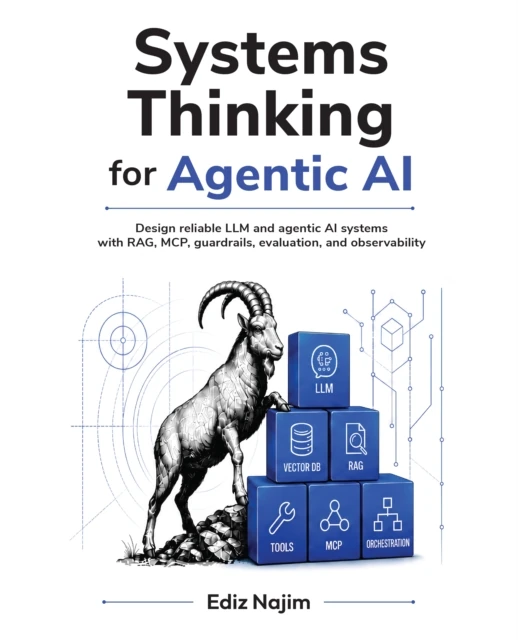
Systems Thinking for Agentic AI
Design reliable LLM and agentic AI systems with RAG, MCP, guardrails, evaluation, and observability

Apply systems thinking to build production-ready LLM and agentic AI systems using RAG, MCP, tools, memory, guardrails, evaluation, observability, and practical architecture patterns
Key Features
Architect reliable AI agent systems beyond prototypes and demos
Build with RAG, MCP, tool calling, memory, and agent orchestration
Engineer for safety, evaluation, observability, cost, and failure handling
Book Description
Engineering a reliable AI system isn't as easy as calling an API. As AI applications move from prototypes to production, you must solve system-level problems the model alone cannot solve: retrieval quality, tool execution, hallucinations, validation, latency, cost, failures, observability, and operational control.
Systems Thinking for Agentic AI gives engineers and architects a practical framework for tackling these challenges. You ll first understand how LLMs work through tokens, embeddings, and transformers, then learn to control their behavior with prompting, structured outputs, and decoding strategies. You ll connect models to real systems using function calling, tools, and MCP, and build grounded RAG pipelines with embeddings and vector databases.
As you progress, you ll design agentic workflows with planning, memory, orchestration, and controlled execution. You ll implement guardrails, permissions, validation, human approval, evaluation, regression testing, and observability through logs, metrics, and traces. You ll also address production concerns including scaling, performance, cost, timeouts, retries, and fallbacks.
Finally, you ll bring these principles together by building an end-to-end Code Review Agent with Spring Boot, giving you a practical blueprint for engineering AI systems you can confidently operate in production.
What you will learn
Understand how tokens, embeddings, and transformers power LLMs
Control LLM behavior with prompts and structured outputs
Connect AI systems to tools using function calling and MCP
Build grounded RAG pipelines with embeddings and vector databases
Design agents using planning, memory, and orchestration
Apply guardrails, validation, permissions, and human approval
Evaluate and debug AI systems with tests, metrics, and traces
Engineer for latency, cost, scaling, retries, and failures
Who this book is for
This book is for technical leads, software architects, software engineers, and backend developers who want to move beyond AI prototypes and build reliable LLM and agentic AI systems for production. No machine learning background is required. Readers should be comfortable with backend development concepts such as APIs, distributed systems, and system design. Java and Spring Boot developers will also benefit from the end-to-end Code Review Agent implementation.