$147.99
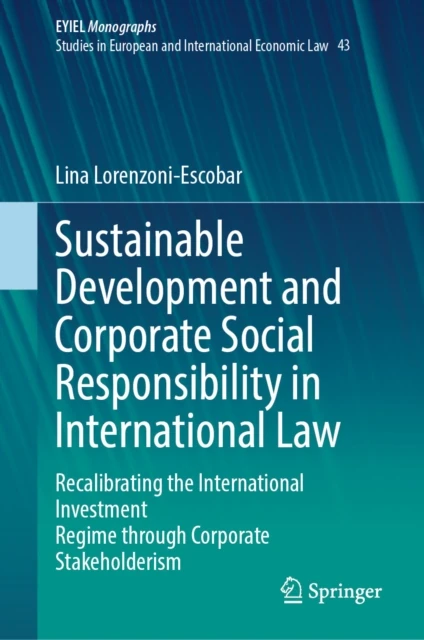
Sustainable Development and Corporate Social Responsibility in International Law
Recalibrating the International Investment Regime through Corporate Stakeholderism

Introduction
Is sustainable development merely a convenient catchphrase or does it have a real bearing on international law? And is corporate social responsibility an internationally legally void concept, subject to unbridled corporate appropriation and misappropriation? This book addresses these two pivotal questions through a transnational lens, combining theoretical and practical insights into sustainable development and corporate social responsibility for academics and legal practitioners alike.
Topics Covered
The book’s chapters address topics such as sustainable development’s legal and normative structure – concluding it is a principled customary international norm –; the interrelation of sustainable development and corporate social responsibility – through what the author refers to as the “principle of stakeholderism” within the UN-led building blocks of sustainable development –; the trend of their inclusion in international investment agreements – which points to the urgency of the current reflection on their normative and legal makeup; and lastly, the implications for international corporate subjectivity of corporate social responsibility as a sustainable development-mandated undertaking.
Author's Perspective
In this regard, the author posits that sustainable development is the binding framework for corporate social responsibility, understood then as a space for regulated corporate self-regulation, where corporate discretion is bound by the objectives, pillars and operative principles of sustainable development.
In turn, the author describes how sustainable development, through corporate social responsibility, realigns international investment agreements, both horizontally and especially vertically. As the implications of this view of corporate subjectivity transcend international investment law, the book represents a valuable contribution to the fields of international economic law, sustainable development, corporate social responsibility, and business and human rights.