$507.99
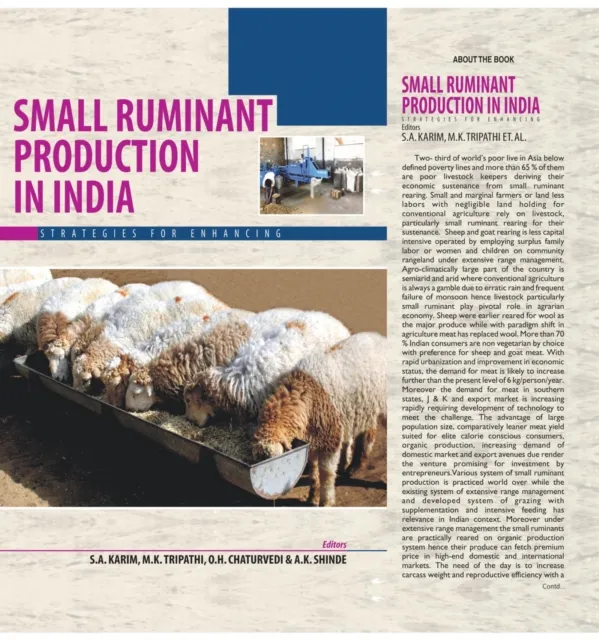
Small Ruminant Production in India

Introduction
Two-third of the world’s poor live in Asia below defined poverty lines and more than 65% of them are poor livestock keepers deriving their economic sustenance from small ruminant rearing. Small and marginal farmers or landless laborers with negligible land holding for conventional agriculture rely on livestock, particularly small ruminant rearing for their sustenance.
Small Ruminant Rearing and Its Significance
Sheep and goat rearing is less capital intensive, operated by employing surplus family labor or women and children on community rangeland under extensive range management. Agro-climatically, a large part of the country is semiarid and arid, where conventional agriculture is always a gamble due to erratic rain and frequent failure of monsoon. Hence, livestock, particularly small ruminants, play a pivotal role in the agrarian economy.
Sheep were earlier reared for wool as the major produce, but with a paradigm shift in agriculture, meat has replaced wool. More than 70% of Indian consumers are non-vegetarian by choice, with a preference for sheep and goat meat. With rapid urbanization and improvement in economic status, the demand for meat is likely to increase further than the present level of 6 kg/person/year.
Moreover, the demand for meat in southern states, Jammu & Kashmir, and the export market is increasing rapidly, requiring development of technology to meet the challenge. The large population size, comparatively leaner meat yield suited for calorie-conscious consumers, organic production, increasing demand of the domestic market, and export avenues make this venture promising for entrepreneurs.
Production Systems and Market Opportunities
Various systems of small ruminant production are practiced worldwide, including extensive range management, grazing with supplementation, and intensive feeding, which have relevance in the Indian context. Under extensive range management, small ruminants are practically reared on organic production systems, allowing their produce to fetch premium prices in high-end domestic and international markets.
The need of the day is to increase carcass weight and reproductive efficiency with strategies to produce more quality meat/animals. To cater to international markets and safeguard consumer interests, practices such as Good Animal Feed Practices (GFPs), Good Hygiene Practices (GHPS), Good Manufacturing Practices (GMPs), and development of Cold Chain systems must be prioritized.
Programs aimed at improving growth rate, feed conversion efficiency, and carcass quality, along with reducing feed input costs per kg of live weight gain, should be implemented as a priority. Efforts should also focus on improving production efficiency, feed supplies, value addition of dressed meat, utilization of slaughter by-products, and development of heat-and-eat quality products to make the venture profitable.
Relevance of the Winter School Program
Given the importance of this issue, the winter school on “Small ruminant production system for commercial mutton production and value addition to augment income generation” is highly relevant for enhancing the quality of meat in the country and increasing income for sheep farmers.
The information contained in this compilation has practical relevance for scientists, teachers involved in research to enhance meat production, as well as progressive farmers and entrepreneurs aiming to commercialize the venture. It will serve as a repository of information on meat production and its value addition in India.