$74.99
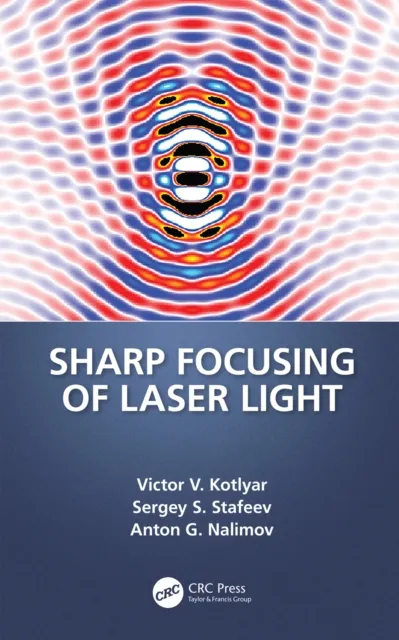
Sharp Focusing of Laser Light

Confined Light and Focal Spot Phenomena
Readers will learn in which ways light can be "confined" within a subwavelength region smaller than half a wavelength. Strictly within the focal spot, all degrees of freedom of light interact and manifest themselves in a dramatic way. The size and shape of the focal spot and the magnitude of side-lobes depend on the polarization state alongside phase and amplitude distributions of a light beam.
Focusing of Inhomogeneously Polarized Beams
Readers will learn techniques in which inhomogeneously (i.e., azimuthally and radially) polarized optical beams can be focused. In sharp focus, exotic phenomena can occur, including the negative propagation of light and a toroidal optical flow.
Numerical Simulation and Photonic Components
Throughout the book, the numerical simulation is performed using the rigorous solution of Maxwell’s equations based on a Finite-Difference Time-Domain (FDTD) approach, which makes the results of modeling highly reliable. The photonic components, including optical metasurfaces, discussed in the book have been implemented using state-of-the-art techniques of electron beam writing and reactive ion-beam etching of microrelief.
Photonic Hot Spots
Two chapters are concerned with photonics hot spots, which deal with the control of light by means of optical metasurfaces and the generation of an energy backflow in the region of sharp focus of a laser beam.
Diffractive Polarization Converters
Another hot topic is diffractive polarization converters implemented as subwavelength diffraction gratings to convert polarization of light. By way of illustration, such converters are shown to perform linear-to-radial or linear-to-azimuthal polarization conversion.
Advanced Photonic Components
The book describes advanced photonic components fabricated by the authors to perform sharp focusing of light, including binary zone plates, binary axicons, a planar photonic crystal lens, diffraction polarization converters, and metalenses.
Conclusion
This book is a must-have for individuals and institutions studying cutting edge optics.