$65.99
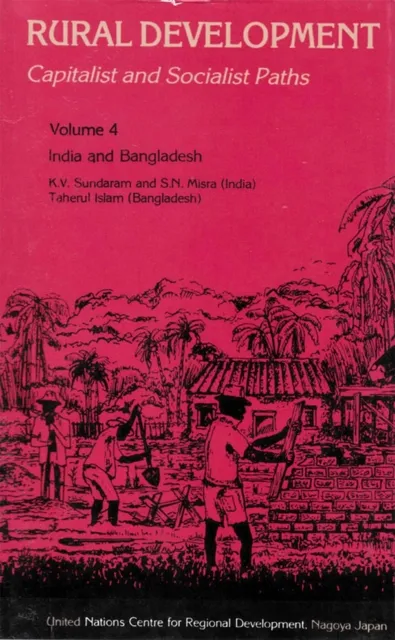
Rural Development: Capitalist and Socialist Paths

Public policy and rural development in India
Public policy is becoming increasingly important in most of the developing countries and the overall development of the society has come to rest on policies pursued by the State. In India a number of public policies for rural development have been launched after the advent of Independence. Of these, the Small Farmers Development Agency (SFDA) is considered a very vital and significant one. Its importance stems from its objective to help the rural poor to cross the poverty line and raise the level of productivity in the rural sector.
The SFDA (now called Integrated Rural Development Programme) has been in existence for about a decade and millions of rupees have been spent under this scheme. Therefore, a frank evaluation of this policy is called for which would help us in not only understanding the nature and impact of a public policy but the scope and limitation of this instrument in bringing about socio-economic development.
The present study seeks to examine not only the viability and impact of the schemes, but also the adequacy and suitability of the existing administrative structures, the role of the pyraveekar—a middleman—and the participation of the target groups in the programme. In examining these factors a detailed analysis of schemes launched by the SFDA is done and their impact on different categories of target groups, namely the small farmers, the marginal farmers and the agricultural labourers is also studied.
It shows how the organisation (including its structures) at the grassroots level and its socio-behavioural dimensions condition the effectiveness of the SFDA. The study shows how crucial is the role played by the bureaucracy in implementing the anti-poverty programmes.
An interesting and important aspect of rural development which has gone unnoticed by the researchers in the field and is brought to light by this study is the pyraveekar, ‘the fixer’, on whom many rural poor depend to get their work done.
Finally, the scope for the participation of the target groups in the implementation of the public policy is described in detail. The book seeks to examine a vital developmental scheme in its larger policy perspective and socioeconomic framework. This is the first in the series of studies on public policy to be brought out by the Centre.