$81.99
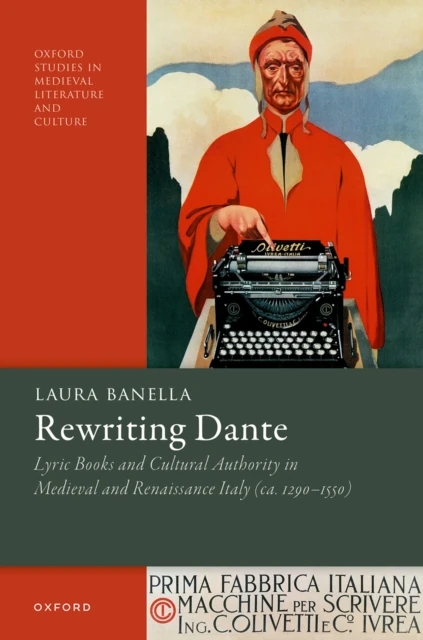
Rewriting Dante
Lyric Books and Cultural Authority in Medieval and Renaissance Italy (ca. 1290-1550)

Rewriting Dante explores how Dante Alighieri''s lyric poetry was copied, edited, and printed across manuscripts and early printed books from ca. 1290 to 1550, revealing the ways in which these processes produced a distinct cultural figure: ''Dante the lyric poet.'' By tracing the material and textual ''rewriting'' of his lyrics, the book reconstructs the formation of Dante''s authoriality and the evolving perception of lyric authority in medieval and Renaissance Italy.The study begins with the earliest anthologies (1290-1325), showing how Dante''s lyric presence was established before the Commedia and how manuscript circulation generated multiple ''Dantes'' independent of his intentions. It then re-examines the Vita nova as a lyric sequence whose narrative structure redefined the boundaries between the lyric and other forms of writing. Subsequent chapters follow Dante''s lyrics through illuminated codices, urban readers and middle-class libraries in Florence, and anthologies compiled by poet-scribes who inserted their own verse alongside Dante''s in order to lay claim to a lineage within the Tuscan canon. The final section moves into the age of print, analyzing the editions encompassing Dante''s lyric poems (1491-1532), paying particular attention to the 1518 Venetian-Milanese edition and to annotated volumes -- both manuscripts and printed copies -- that reconfigure the texts and transform books into means of personal or amorous expression and exchange.Through the lens of material transmission, Rewriting Dante redefines what it meant to be an ''author'' and a ''poet'' between the Middle Ages and the Renaissance, showing how scribes, readers, and editors continually reshaped Dante''s authority as a lyric figure distinct, yet inseparable, from the poet of the Commedia.