$32.99
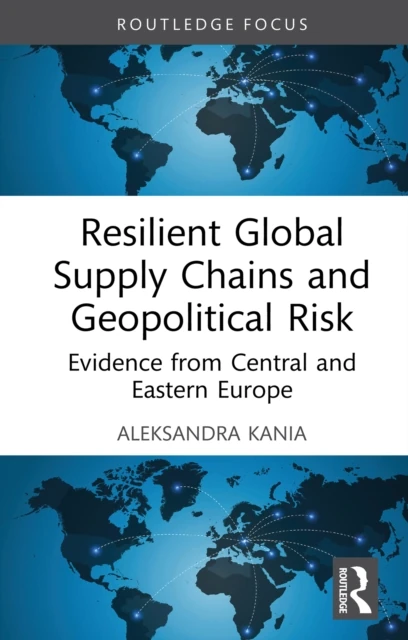
Resilient Global Supply Chains and Geopolitical Risk
Evidence from Central and Eastern Europe

Global supply chains and geopolitical uncertainty
Global supply chains, long seen as engines of efficiency and economic integration, have been increasingly disrupted by recent crises, including the COVID-19 pandemic, armed conflicts, and shifts in trade and industrial policy. These developments have raised costs, increased uncertainty, and reduced the predictability of cross-border production and exchange. Firms operating in Central and Eastern Europe (CEE) face particularly strong pressures as overlapping geopolitical forces reshape production networks, market access, and strategic choices.
Supply chain resilience in the face of geopolitical risks
This book examines how firms build and sustain supply chain resilience (SCRES) under persistent geopolitical uncertainty. It maps how research on SCRES has evolved and provides detailed empirical evidence on how firms in the CEE region respond to geopolitical risk. Focusing on practical adjustment mechanisms such as supplier diversification, nearshoring, inventory buffering, and route reconfiguration, this book analyses how firms adapt supply chains in environments shaped by sanctions, trade disputes, and regulatory fragmentation.
Methodology and conceptual framework
Using qualitative case studies and causal modelling, the analysis shows that resilience does not result from isolated decisions or single best practices. Instead, it emerges from the interaction of multiple strategic choices made over time. By combining insights from dynamic capabilities, institutional economics, and systems thinking, this book conceptualises SCRES as an economic outcome shaped by firms’ responses to changing costs, governance constraints, and information conditions under geopolitical pressure.
Intended audience
The book is intended for researchers and graduate students in supply chain management, economics, international business, and related fields, as well as for policymakers and practitioners concerned with geopolitical risk, industrial adjustment, and resilience in global production networks.