$16.99
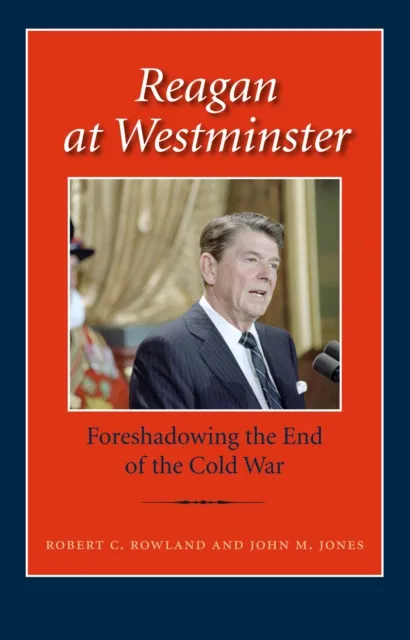
Reagan at Westminster
Foreshadowing the End of the Cold War

President Ronald Reagan’s famous address to the Houses of Parliament
is now considered—in its spirit if not in its actual words—to be the initial enunciation of his “Evil Empire” stance. In this important volume by two experienced rhetorical scholars, Robert C. Rowland and John M. Jones offer a historical-descriptive treatment that includes both rhetorical analysis and a narrative of the drafting of the speech. They consider Reagan’s focus on “ultimate definition,” “dialectical engagement,” and other rhetorical tools in crafting and presenting the momentous address. They also note the irony of Reagan’s use of Leon Trotsky’s phrase “ash-heap of history” to predict the demise of Communism.
Rowland and Jones present three reasons for the importance of this speech. First, it offers new insights into President Reagan himself, through a view of his role in the drafting of the speech as well as the ideas it contains. Second, the speech is an act of rhetorical history, and its analysis helps recover a significant rhetorical artifact. Finally, the address ultimately expresses a rhetorical framework for the Cold War that systematically subverted the narrative, ideology, and values of Marxism.
Although initial response to the speech was tepid, Reagan considered it one of his most important addresses, and the hindsight afforded by the fall of Communism a decade later lends validation to that view, the authors suggest. Reagan at Westminster: Foreshadowing the End of the Cold War will highly commend itself to students and scholars of rhetoric, the Presidency, and political communication.