$26.49
$43.99
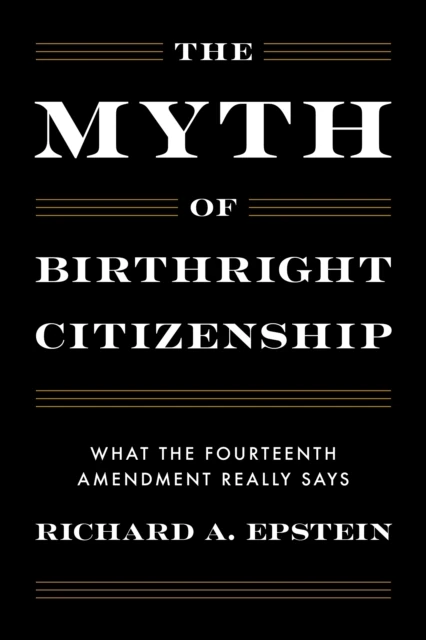
Myth of Birthright Citizenship
What the Fourteenth Amendment Really Says

The Citizenship Clause and Birthright Citizenship
The Citizenship Clause of the Fourteenth Amendment of the U.S. Constitution seems quite simple. Yet it is embroiled in one of the most contentious constitutional battles of our time: birthright citizenship. In The Myth of Birthright Citizenship, Richard A. Epstein explains what the Constitution actually says about citizenship and what it doesn't.
Many believe that the Citizenship Clause bestows citizenship upon anyone born in the United States, but Epstein explains why this understanding is profoundly wrong. On the contrary, acquiring citizenship requires one to be subject to the jurisdiction of a sovereign or to offer loyalty in exchange for protection. It is not sufficient to obtain citizenship by simply living within the jurisdiction of a state. Therefore, mere birth of an alien in the U.S. does not grant him citizenship but only allows him, as a minor, to be naturalized when his parents are naturalized.
Epstein's Evidence and Historical Analysis
Epstein's powerful evidence for this position comes from a close textual analysis of the Constitution. It is enriched by a study of the overlooked Naturalization Acts from 1790 to 1870; the writings of such giants as William Blackstone and Emmerich de Vattel before the American Revolution; the mixed reception of English practice in America after the Revolutionary War at both the state and federal levels; and the case law and institutional practices in this country both before and after the Civil War, which include a study of black and Chinese naturalization history.
Impact on Constitutional Doctrine and Recent Debates
The book also examines how earlier debates over birthright citizenship have helped shape the evolution of constitutional doctrine throughout the twentieth century on such key questions as voting rights, segregated schools, takings, taxation, and unconstitutional conditions. It further examines the responses of judges and commentators to President Trump's January 20, 2025, executive order prohibiting the executive branch from issuing documents recognizing the citizenship of those claiming birthright citizenship.


