£85.00
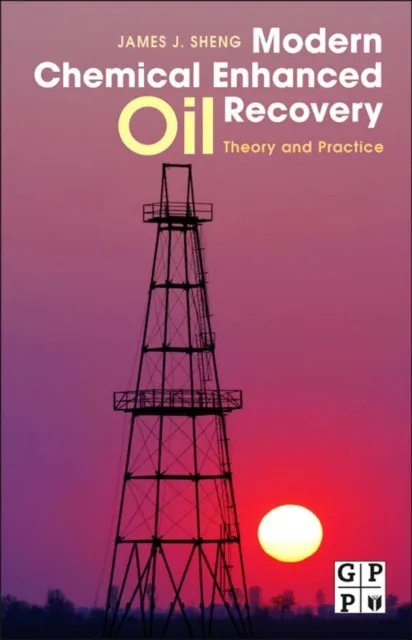
Modern Chemical Enhanced Oil Recovery
Theory and Practice

Crude Oil Development and Production Phases
Crude oil development and production in U.S. oil reservoirs can include up to three distinct phases: primary, secondary, and tertiary (or enhanced) recovery. During primary recovery, the natural pressure of the reservoir or gravity drive oil into the wellbore, combined with artificial lift techniques (such as pumps) which bring the oil to the surface. But only about 10 percent of a reservoir's original oil in place is typically produced during primary recovery.
Secondary recovery techniques extend the field’s productive life generally by injecting water or gas to displace oil and drive it to a production wellbore, resulting in the recovery of 20 to 40 percent of the original oil in place.
Recent Developments in Enhanced Oil Recovery (EOR)
In the past two decades, major oil companies and research organizations have conducted extensive theoretical and laboratory EOR (enhanced oil recovery) research, including validating pilot and field trials relevant to much-needed domestic commercial application, while western countries had terminated such endeavors almost completely due to low oil prices. In recent years, oil demand has soared and now these operations have become more desirable.
About the Book
This book is about the recent developments in the area as well as the technology for enhancing oil recovery. It provides important case studies related to over one hundred EOR pilot and field applications in a variety of oil fields. These case studies focus on practical problems, underlying theoretical and modeling methods, operational parameters (e.g., injected chemical concentration, slug sizes, flooding schemes and well spacing), solutions and sensitivity studies, and performance optimization strategies. The book strikes an ideal balance between theory and practice, and would be invaluable to academicians and oil company practitioners alike.
Updated chemical EOR fundamentals providing a clear picture of fundamental concepts
Practical cases with problems and solutions providing practical analogues and experiences
Actual data regarding ranges of operation parameters providing initial design parameters
Step-by-step calculation examples providing practical engineers with convenient procedures