£89.50
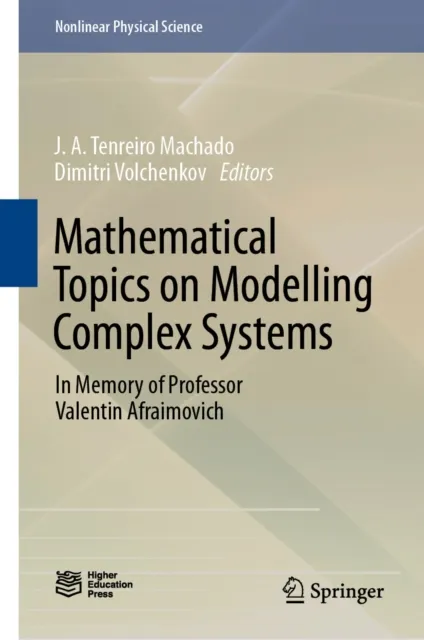
Mathematical Topics on Modelling Complex Systems
In Memory of Professor Valentin Afraimovich

Part 1: Mathematical Tools for Engineering and Social Science
This book explores recent developments in theoretical research and mathematical modelling of real-world complex systems, organized in four parts.
The first part of the book is devoted to the mathematical tools for the design and analysis in engineering and social science study cases. We discuss the periodic evolutions in nonlinear chemical processes, vibro-compact systems and their behaviour, different types of metal–semiconductor self-assembled samples, made of silver nanowires and zinc oxide nanorods.
Part 2: Mathematical Description and Modelling of Critical Events
The second part of the book is devoted to mathematical description and modelling of the critical events, climate change and robust emergency scales. In three chapters, we consider a climate-economy model with endogenous carbon intensity and the behaviour of Tehran Stock Exchange market under international sanctions.
Part 3: Fractional Dynamic and Control Problems
The third part of the book is devoted to fractional dynamic and fractional control problems. We discuss the novel operational matrix technique for variable-order fractional optimal control problems, the nonlinear variable-order time fractional convection–diffusion equation with generalized polynomials.
Part 4: Solvability and Inverse Problems
The fourth part of the book concerns solvability and inverse problems in differential and integro-differential equations.
Additional Information
The book facilitates a better understanding of the mechanisms and phenomena in nonlinear dynamics and develops the corresponding mathematical theory to apply nonlinear design to practical engineering. It can be read by mathematicians, physicists, complex systems scientists, IT specialists, civil engineers, data scientists and urban planners.