$67.99
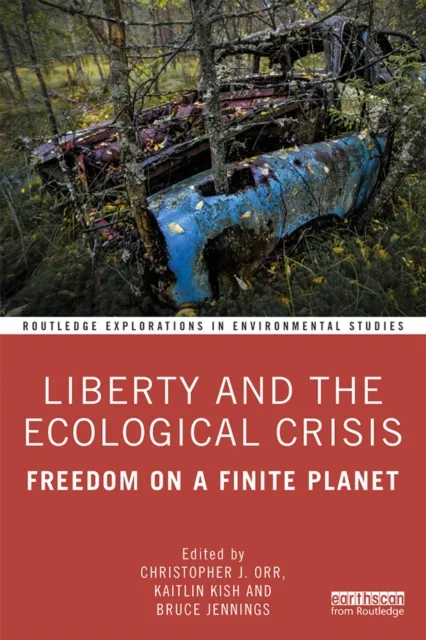
Liberty and the Ecological Crisis
Freedom on a Finite Planet

Introduction
This book examines the concept of liberty in relation to civilization’s ability to live within ecological limits.
Freedom, in all its renditions – choice, thought, action – has become inextricably linked to our understanding of what it means to be modern citizens. And yet, it is our relatively unbounded freedom that has resulted in so much ecological devastation. Liberty has piggy-backed on transformations in human–nature relationships that characterize the Anthropocene: increasing extraction of resources, industrialization, technological development, ecological destruction, and mass production linked to global consumerism. This volume provides a deeply critical examination of the concept of liberty as it relates to environmental politics and ethics in the long view. Contributions explore this entanglement of freedom and the ecological crisis, as well as investigate alternative modernities and more ecologically benign ways of living on Earth. The overarching framework for this collection is that liberty and agency need to be rethought before these strongly held ideals of our age are forced out. On a finite planet, our choices will become limited if we hope to survive the climatic transitions set in motion by uncontrolled consumption of resources and energy over the past 150 years. This volume suggests concrete political and philosophical approaches and governance strategies for learning how to flourish in new ways within the ecological constraints of the planet.
Conclusion
Mapping out new ways forward for long-term ecological well-being, this book is essential reading for students and scholars of ecology, environmental ethics, politics, and sociology, and for the wider audience interested in the human–Earth relationship and global sustainability.