$80.99
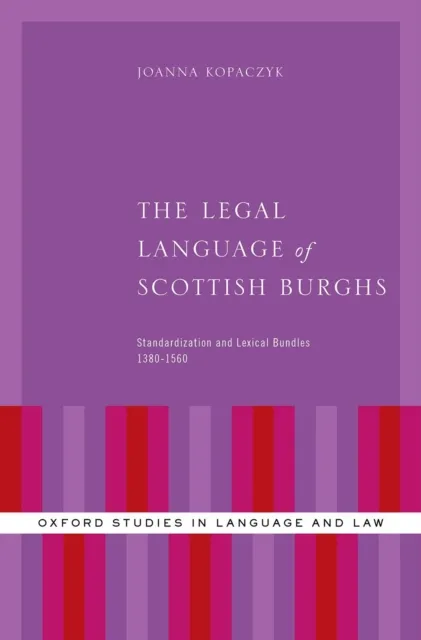
Legal Language of Scottish Burghs
Standardization and Lexical Bundles (1380-1560)

Overview
This book offers an innovative, corpus-driven approach to historical legal discourse. It is the first monograph to examine textual standardization patterns in legal and administrative texts on the basis of lexical bundles, drawing on a comprehensive corpus of medieval and early modern legal texts.
Focus and Context
The book's focus is on legal language in Scotland, where law—with its own nomenclature and its own repertoire of discourse features—was shaped and marked by the concomitant standardizing of the vernacular language, Scots, a sister language to the English of the day.
Methodology
Joanna Kopaczyk's study is based on a unique combination of two methodological frameworks: a rigorous corpus-driven data analysis and a pragmaphilological, context-sensitive qualitative interpretation of the findings.
Historical and Sociolinguistic Insights
Providing the reader with a rich socio-historical background of legal discourse in medieval and early modern Scottish burghs, Kopaczyk traces the links between orality, community, and law, which are reflected in discourse features and linguistic standardization of legal and administrative texts.
Key Topics
In this context, the book also revisits important ingredients of legal language, such as binomials or performatives. Kopaczyk's study is grounded in the functional approach to language and pays particular attention to referential, interpersonal, and textual functions of lexical bundles in the texts.
Contributions and Implications
It also establishes a connection between the structure and function of the recurrent patterns, and paves the way for the employment of new methodologies in historical discourse analysis.