£4.99
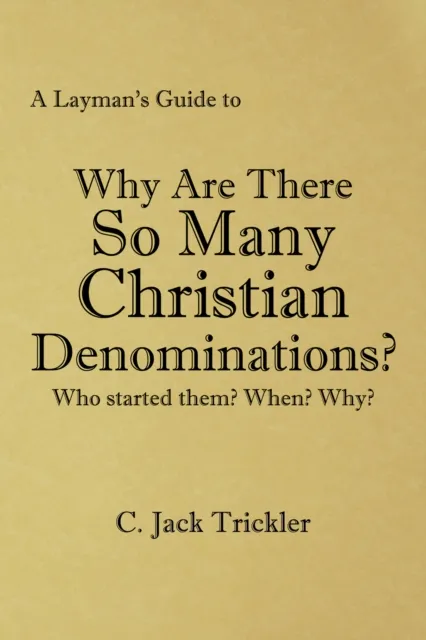
Layman'S Guide To
Why Are There so Many Christian Denominations?

Introduction
This history of the origins and development of Christian denominations is in laymans language. Readers will not become bogged down in technical or archaic terms. Begin by reading about the Christian groups, denominations, that developed in the time between Jesus crucifixion and the formal origins of the Roman Catholic and Orthodox churches. Learn how the Roman empire came to accept Christianity as its religion, of the cooperation and struggles between the Roman Catholic and Orthodox churches and how that led to their separation.
The Reformation and Its Aftermath
Read about how the Black Death, the Crusades, the struggles within the Roman Catholic Church led some church leaders, such as Martin Luther, to attempt to reform the church, and how those attempts led to The Reformation. That opened the door to England declaring that the Church of England, the Anglican Church is the true Christian church. John Calvin laid the ground work for what became the Presbyterian and the Reformed churches. Then came the Huguenots and the Walloons, and the Puritan-Pilgrims who came to America and evolved into such as the Congregationalists.
Persecution and New Movements
Back in England the Quakers experienced persecution that encouraged them to move to America. John Wesley began what evolved into Methodism. The American Revolution caused American churches of English origin to separate from their English roots and to become such as the Episcopalians and the Methodists.
Denominations in the United States
Read about the history of the many denominations that have come into being in The United States. There are the numerous Christian churches, the Unitarians, Spiritualist churches, Mormons, Adventists, Jehovahs Witnesses, Christian Science, Pentecostalism and many independent non-denominational churches.
Conclusion
It is fascinating history, and all in laymans language.