£89.50
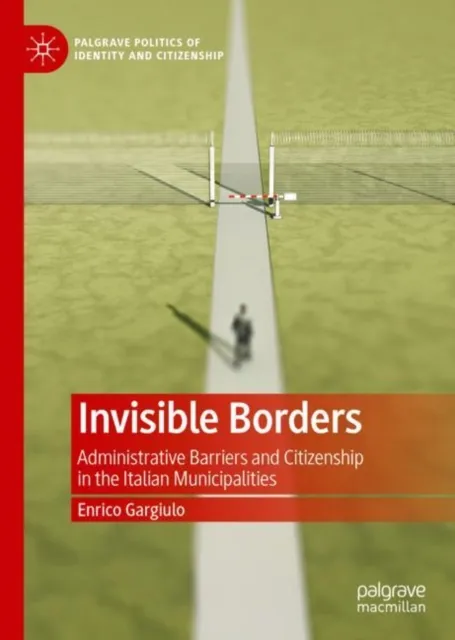
Invisible Borders
Administrative Barriers and Citizenship in the Italian Municipalities

Analysis of Residency and Local Citizenship
This book analyses residency, a form of municipal membership that plays a strategic role in administrative processes in Italy. Residency is a two-faced juridical status: a means for exercising rights and moving freely within a state territory and, at the same time, a tool of control that operates through identification and registration. Gargiulo investigates residency both historically and theoretically, showing that the status of resident is a special kind of border, namely, a status border, which draws the lines of local citizenship. By explaining that the mechanisms of exclusion from residency work as administrative barriers, and showing their aims and effects in terms of civic stratification and differential inclusion, this book contributes to the debates on local citizenship, borders, and discretionary power.
Endorsements
‘While the legal concepts of (un)authorized presence and citizenship in bounded territorial states govern how we envision “immigrants” and debate their treatment, this perceptive book raises novel issues. Local residency registration, studied with rich material from Italy, regulates access to socially distributed resources, and shapes stratification of labor. The case made in this book is original, penetrating, and theoretically insightful. Scholars of migration will want to read this exceptional work.’
— Josiah Heyman, University of Texas at El Paso, USA
‘Enrico Gargiulo has made an important addition to our sociological understanding of the ways in which states and individuals relate to one another. The humble, often taken-for-granted status of "resident" turns out to be a major pathway to rights and privileges for individuals who have it; those without it may be legal non-persons who barely exist in the eyes of the state. This book is a major contribution to our expanding appreciation of the many kinds of borders, both physical and conceptual, that shape our relationships with the social and political world.’
— John Torpey, Presidential Professor of Sociology and History, Director, Ralph Bunche, Institute for International Studies, CUNY Graduate Center, USA