$217.99
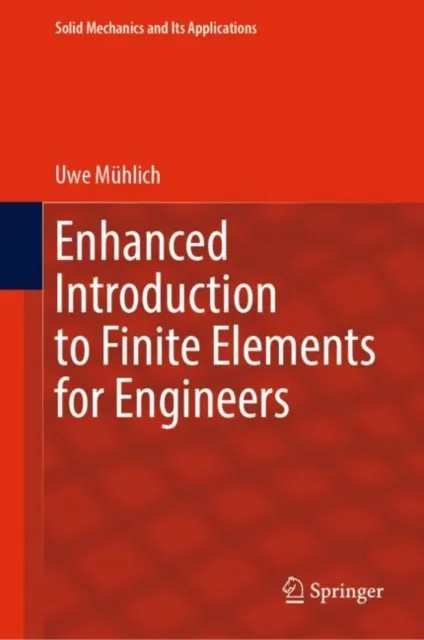
Introduction to the Finite Element Method with the Variational Approach

An Introduction to the Finite Element Method with the Variational Approach
offers a comprehensive solution to the gaps often found in introductory texts on the Finite Element Method (FEM). The book provides a thorough introduction to the fundamental principles of linear and time-independent FEM within the variational framework. It meticulously covers the derivation of 1-D FEM equations based on variational functionals, encompassing both linear and higher-order elements, and shape functions driven by convergence criteria. Furthermore, it explores 1-D numerical integration, outlines coding procedures, and provides insights into handling material nonlinearity and time-dependent scenarios.
Expanding into 2-D problems, the book offers derivations of 2-D FEM equations tailored to diverse engineering disciplines, including Steady-State Heat Conduction, Solid Mechanics (covering torsion, plane strain/axisymmetric cases, and the bending, stability, and vibrations of thin plates), as well as Fluid Mechanics (addressing incompressible inviscid and viscous fluids). It includes detailed discussions on element continuity, numerical integration techniques, and even includes 2-D codes for selected problems. The book concludes by delving into recent advancements in FEM, with a specific focus on applications in machine learning and isogeometric analysis.
Explains the fundamentals of the Finite Element Method (FEM) with a focus on linear and time-independent aspects, employing a variational approach
Covers variational FEM formulations for 1-D and 2-D scenarios in solid mechanics, fluid mechanics, and heat conduction problems.
Explores the application of 1-D Galerkin FEM to address challenges presented by material nonlinearity and time-dependent problems
Delves into the intricacies of FEM algorithms and provides a comprehensive overview of coding implementation.