$145.99
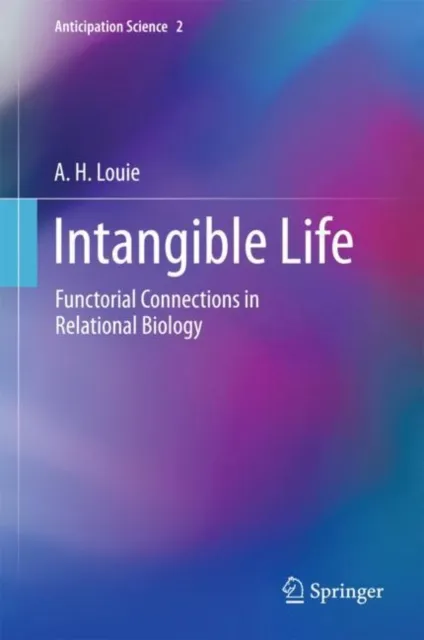
Intangible Life
Functorial Connections in Relational Biology

Exploratory Journey in Relational Biology
This rare publication continues an exploratory journey in relational biology, a study of biology in terms of the organization of networked connections in living systems. It builds on the author’s two earlier monographs which looked at the epistemology of life and the ontogeny of life. Here the emphasis is on the intangibility of life, that the real nature of living systems is conveyed not by their tangible material basis but by their intangible inherent processes.
Introduction to Relational Biology
Relational biology is the approach that hails ‘function dictates structure’; it is mathematics decoded into biological realizations. Therefore, the work begins with a concise introduction to category theory, equiping the reader with the mathematical metalanguage of relation biology. The book is organized around three parts:
Part I
is a comprehensive study of the most important functor in relational biology, the power set functor. The author lays the set-theoretic foundations of the functorial connections in relational biology, exploring relations, mappings, and set-valued mappings.
Part II
Natural Law receives a new mathematical formulation founded on two axioms: ‘Everything is a set’ and ‘Every process is a set-valued mapping’. The reader sees how Metabolism–Repair networks, equipped with set-valued processors, expand their role from models of biological entities to generic models of all natural systems.
Part III
expounds the various shades of invertibility in general, and the inversion of encoding to decoding in particular. A plethora of mathematical and biological examples illustrate the category-theoretic concepts of equivalence and adjunction.
Target Audience
This book's algebraic approach to biological models will appeal to researchers and graduate students in mathematics, biology, and the philosophy of science.