$253.99
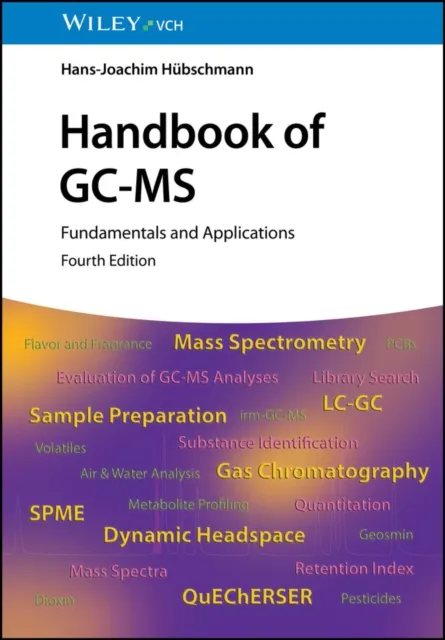
Handbook of GC-MS
Fundamentals and Applications

Essential handbook for all analytical scientists and laboratories using GC-MS, covering both the fundamental and practical aspects of this analytical technique
From essentials to applications, Handbook of GC-MS:Fundamentals and Applications is a comprehensive reference and training compendium on the popular and evolving technique of GC-MS (gas chromatography/mass spectrometry), guiding readers through the most used sample preparation methods for GC-MS and method development, with many practical indications supporting the design of optimized analyses, and providing practical approaches to data processing, compound identification, and quantification.
The text details both a solid background and principles of operation, as well as a broad range of current real-life examples taken from laboratories in environmental, food, pharmaceutical, and forensic analysis. It also features a glossary of more than 300 terms, and a comprehensive substance index that facilitates finding a specific application.
This timely Fourth Edition covers the latest developments in automated sample preparation techniques and instrumentation, also with the focus on Green Analytical Chemistry. This comprehensive handbook presents GC-MS applications in various fields, with coverage of the well-known QuEChERS pesticide extraction, solid phase extraction and solid phase microextraction, static and dynamic headspace analysis, liquid/liquid extraction, outgassing, and thermal desorption, including pyrolysis. Single and triple quadrupole, Orbitrap, time-of-flight, magnetic sector, ion mobility and isotope ratio MS are discussed with their advantages and limitations.
Sample topics covered in Handbook of GC-MS: Fundamentals and Applications include:
- Sample inlet systems for hot needle, liquid band injection with large volume and LC-GC application, carrier gas saving, choice of columns, septa and injection port liners
- Optimization of the GC method with carrier gas flow, effect of oven temperature ramp rates, fast GC, and multi-dimensional gas chromatography
- Ionization processes, electron and chemical ionization, resolution power in mass spectrometry, reading and interpreting mass spectra
- Extraction of mass spectra, manual spectrum subtraction, deconvolution of mass spectra, retention index, and library search of mass spectra
- Typical mass spectra of common analyte groups like pesticides, persistent organic pollutants, drugs; explosives; and of frequently occurring impurities
- Quantification using external and internal standards and standard addition methods. Determination of the limits of detection and quantitation.
- Applications covering food, water, flavor and fragrance, metabolomics, forensic and material analysis