$73.99
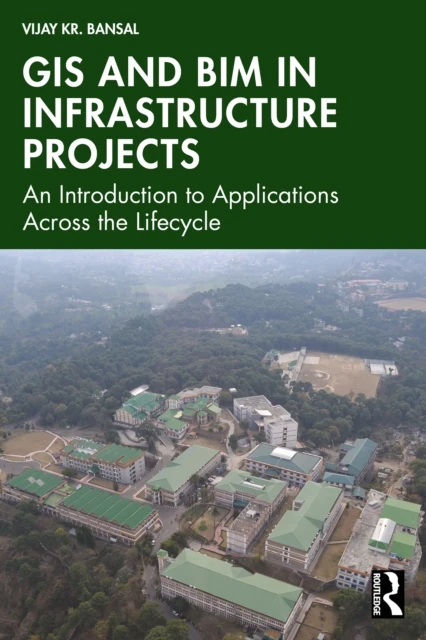
GIS and BIM in Infrastructure Projects
An Introduction to Applications Across the Lifecycle

GIS and BIM in Infrastructure Projects: An Introduction to Applications Across the Lifecycle
demonstrates how geographic information systems (GIS) can complement building information modelling (BIM) throughout infrastructure development. While BIM focuses on geometrical and internal functional characteristics, GIS provides an essential wider locational context and spatial awareness, creating comprehensive solutions for infrastructure lifecycle management. The book emphasizes that infrastructure lifestyle planning cannot be done in isolation but must consider surrounding facilities, utilities, neighbourhoods, and topography.
Structured around nine chapters covering all lifecycle stages of infrastructure projects
After introducing GIS fundamentals, the text explores specific applications across six lifecycle stages: feasibility (database management, site selection, environmental impact assessment), design (public participation, cost estimation, sunlight visualization), construction planning (scheduling, 4D modeling, safety planning), construction (contractor screening, site layout, materials management), operation and maintenance (infrastructure resilience, energy performance), and demolition (waste management, environmental impacts). Each chapter begins with learning objectives and concludes with summaries, supported by high-quality figures and illustrations. The final chapter identifies future research directions across all stages.
Intended Audience
This is an ideal textbook for graduate and undergraduate students in architecture, engineering, and construction programs, as well as a useful book for AEC industry professionals seeking to implement GIS and BIM technologies in combination. It serves as a useful classroom resource and self-study manual, addressing the growing need for integrated BIM-GIS solutions in sustainable infrastructure development and lifecycle management.