$78.99
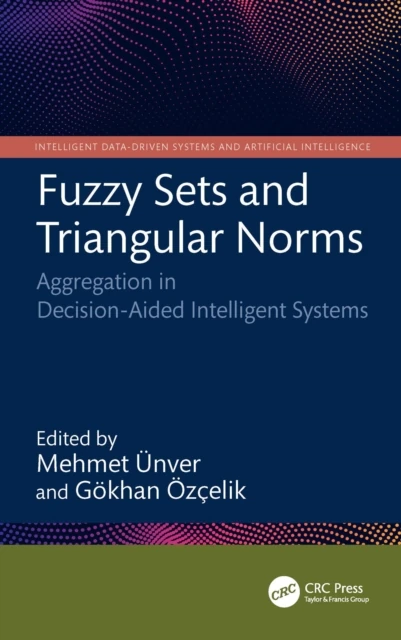
Fuzzy Sets and Triangular Norms
Aggregation in Decision-Aided Intelligent Systems

Introduction
This book aims to serve as a comprehensive resource that equips readers with the knowledge and practical skills needed to navigate the intricacies of fuzzy set theory, t-norms, and their integration into decision-aided intelligent systems.
Aggregation Operators and Data Fusion
It provides a comprehensive understanding of aggregation operators and their role in data fusion, risk analysis, and expert opinion aggregation. New aggregation operators, entropy measures, t-norm, and t-conorm structures are developed across multiple fuzzy set extensions to better model uncertainty and hesitation in decision-making.
Applications
A wide range of real-world applications, including, tourism planning, smart cities, urban mobility, water security, smart campus automation, energy facility siting, and firefighting helicopter selection, are addressed using advanced multi-criteria decision making methods.
Decision Support and Techniques
The chapters collectively emphasize sustainable, data-driven, and uncertainty-aware decision support, contributing solutions in areas such as environmental protection, resource optimization, public services, and technological infrastructure. Innovative techniques, such as Lambert W-based aggregation operators, Choquet integral-based entropy, confidence-level aggregation, and fuzzy-machine learning hybrid models, improve the representation of interaction, ambiguity, and complexity in multi-criteria decision problems.
Target Audience
The text is primarily written for senior undergraduates, graduate students, and academic researchers in diverse fields including mathematics, industrial engineering, supply chain management, operations research, manufacturing engineering, production engineering, and applied mathematics.