$45.99
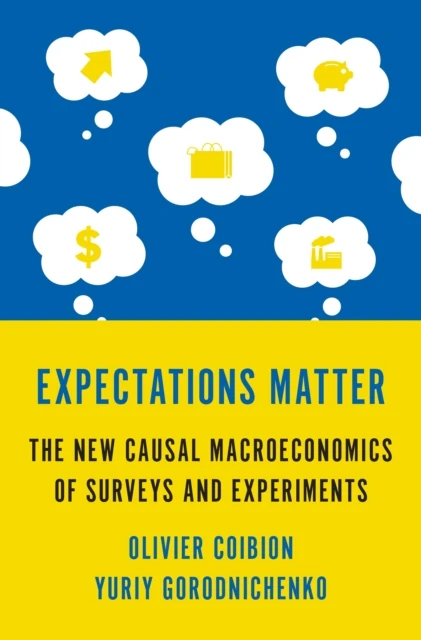
Expectations Matter
The New Causal Macroeconomics of Surveys and Experiments

What people believe about the economy and why it matters
How do expectations about the future influence economic behavior? For decades, economists have known that beliefs play a central role from how much households spend, to how firms set prices, to how central banks design policy. But figuring out exactly how expectations affect decisions has been one of the field's most persistent empirical challenges.
Empirical approach and research
In this book, Olivier Coibion and Yuriy Gorodnichenko present a fresh empirical approach: using randomized controlled trials (RCTs) to study the causal impact of expectations. Drawing on more than a decade of their research, they show how targeted information treatments can generate experimental variation in beliefs making it possible to measure how those beliefs influence real-world decisions. Along the way, they reassess the limits of the traditional rational expectations framework and offer a richer, evidence-based picture of how people form and act on their views about the economy.
Methodology and focus
Blending the credibility of field experiments with the big-picture questions of macroeconomics, the authors provide a clear, practical guide to this new methodology from survey design to implementation to measuring how beliefs pass through into behavior. While much of the book focuses on inflation expectations, later chapters explore how this approach sheds light on the role of uncertainty in firm and household decision making, the influence of expectations on financial behavior, and how peer effects shape household spending. For economists and social scientists alike, this book offers a new lens on how beliefs work and why they matter.