$93.99
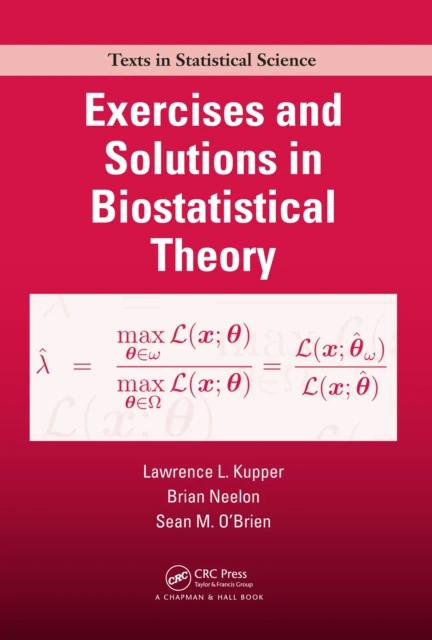
Exercises and Solutions in Biostatistical Theory

Introduction
Drawn from nearly four decades of Lawrence L. Kupper's teaching experiences as a distinguished professor in the Department of Biostatistics at the University of North Carolina, Exercises and Solutions in Biostatistical Theory presents theoretical statistical concepts, numerous exercises, and detailed solutions that span topics from basic probability to statistical inference. The text links theoretical biostatistical principles to real-world situations, including some of the authors' own biostatistical work that has addressed complicated design and analysis issues in the health sciences.
Content and Structure
This classroom-tested material is arranged sequentially starting with a chapter on basic probability theory, followed by chapters on univariate distribution theory and multivariate distribution theory. The last two chapters on statistical inference cover estimation theory and hypothesis testing theory. Each chapter begins with an in-depth introduction that summarizes the biostatistical principles needed to help solve the exercises. Exercises range in level of difficulty from fairly basic to more challenging (identified with asterisks).
Learning Outcomes
By working through the exercises and detailed solutions in this book, students will develop a deep understanding of the principles of biostatistical theory. The text shows how the biostatistical theory is effectively used to address important biostatistical issues in a variety of real-world settings. Mastering the theoretical biostatistical principles described in the book will prepare students for successful study of higher-level statistical theory and will help them become better biostatisticians.