$98.99
Electromagnetism for Chemistry

Introduction
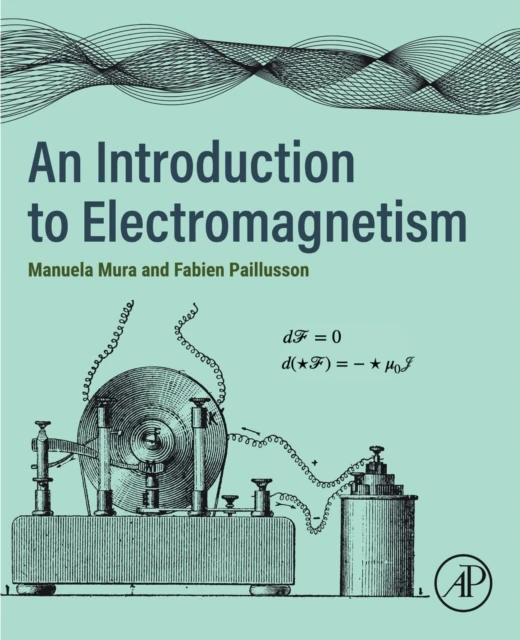
This textbook presents an introduction to electromagnetism intended for undergraduate and graduate students in chemistry, chemical engineering, materials science, and related areas.
The book requires no pre-existing knowledge of physics beyond Coulomb’s Law and the idea that electric currents serve as the source of magnetic fields. Only mathematics up through vector calculus is assumed.
Supplementary Material
As a supplement to these basic concepts, there is an extensive appendix with clear explanations of the theorems and mathematical methods of electromagnetism that go beyond the vector calculus. Each equation in the text and in the appendix is derived with no details left out.
Structure of the Book
The book is divided into two sections; the first covers electrostatics while the second covers electrodynamics.
Electrostatics
The first section introduces the theory of charges and electric dipoles with illustrations of their application to the properties of dielectrics, colloids, polymers, and electrolyte solutions.
Electrodynamics
The second section introduces Maxwell’s equations and covers electromagnetic waves, light scattering, X-ray diffraction, spectroscopy, optical rotation, and the dispersive intermolecular forces, including Forster resonance energy transfer and the Hamaker force.
Additional Chapters
In order to make the application of the theory of electromagnetism to chemistry complete, the book includes stand-alone chapters covering the relevant parts of thermodynamics, statistical mechanics, classical mechanics, and quantum mechanics.
Conclusion
The combination of clarity of presentation and careful attention to pedological detail serves to recommend the book as a source for self-study to students and also practicing physical chemists, who may need to refresh their memory of the various details of electromagnetism.