£1.24
Egg
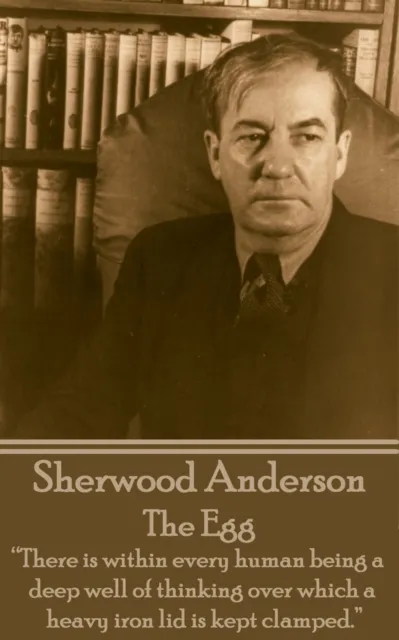
“There is within every human being a deep well of thinking over which a heavy iron lid is kept clamped.”

Sherwood Anderson
Born on September 13, 1876, in Camden, Ohio. He was pretty much self-educated and his early career was that of a successful copywriter and business owner in both Cleveland and Elyria in Ohio. In November 28th, 1912, he suffered a nervous breakdown. It led to him abandoning both his business and his family to become a writer. Sherwood's first novel, Windy McPherson's Son, was published in 1916 as part of a three-book deal. This book, along with his second novel, Marching Men (published in 1917), prepared him for the success and fame he was to find with Winesburg, Ohio, a collection of interrelated short stories published in 1919. In his memoir, he wrote that "Hands" was the first "real" story he ever wrote.
Despite writing further short story collections, novels, plays, essays, and poetry as well as a memoir, only his novel Dark Laughter, written in 1925, could claim to be a commercial bestseller. His influence on the next generation of writers was immense. He not only helped to obtain publication for William Faulkner and Ernest Hemingway but was an inspiration to writers of the calibre of John Steinbeck and Thomas Wolfe.
Sherwood Anderson died on March 8th, 1941, at the age of 64. He was taken ill during a cruise to South America and disembarked with his wife for the hospital in Colón, Panama, where he died. An autopsy revealed he had swallowed a toothpick, which had damaged his internal organs and promoted infection. Sherwood's body was returned to the United States, where he was buried at Round Hill Cemetery in Marion, Virginia. His epitaph reads, "Life, Not Death, is the Great Adventure".
Here we publish the classic The Egg.