£2.40
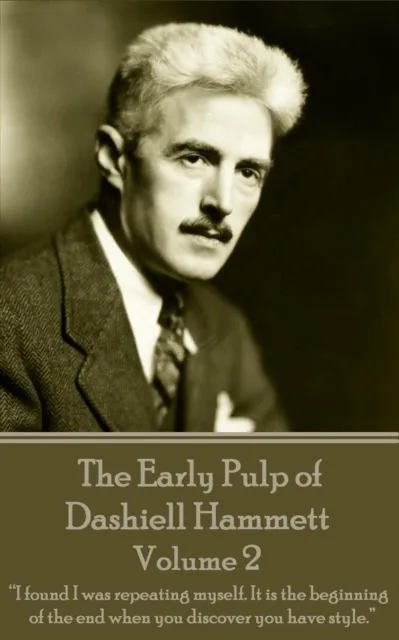
Early Pulp of Dashiell Hammett - Volume 2
“I found I was repeating myself. It is the beginning of the end when you discover you have style.”

Samuel Dashiell Hammett
Born on May 27th, 1894 at Saint Mary''s County, Maryland. Despite a short education, he laid the groundwork for his classic writing by later working for the famous Pinkerton National Detective Agency. During this employment, he took time off to serve in the war, but this was limited to catching Spanish flu and then tuberculosis, ensuring he spent most of his Army time as a patient at Cushman Hospital in Tacoma, Washington. His health issues had become further exacerbated by his heavy drinking, and by the time he was writing full time, he had become an alcoholic.
That jump into writing was immeasurably helped by his work at Pinkertons, which provided both source material and inspiration, especially for his earlier works in the 1920s centered on detective fiction. His first published work was in 1922 for the magazine, The Smart Set. This would lead to his hard-boiled pulp classics; Red Harvest, The Maltese Falcon, The Glass Key, and The Thin Man being his most well known. As Raymond Chandler said of him, “He wrote scenes that seemed never to have been written before.”
By 1934, Hammett had written his last novel and was embarked on a 30-year affair with playwright Lillian Hellman. His left-wing politics clashed with the government, and in 1951, after refusing to answer questions on the whereabouts of several convicted but absconded colleagues, Hammett was found guilty of contempt of court and served time in a West Virginia federal penitentiary, where, apparently, he was assigned to cleaning toilets. He testified on March 26, 1953, before the House Un-American Activities Committee about his own activities but refused to cooperate with the committee and was blacklisted.
As the years of the 1950s wore on, Hammett became reclusive and no longer engaged with things that he had once loved, even his typewriter. On January 10, 1961, Hammett died in New York City’s Lenox Hill Hospital, of lung cancer, diagnosed just two months before. As a veteran of two World Wars, he was buried at Arlington National Cemetery.