£109.50
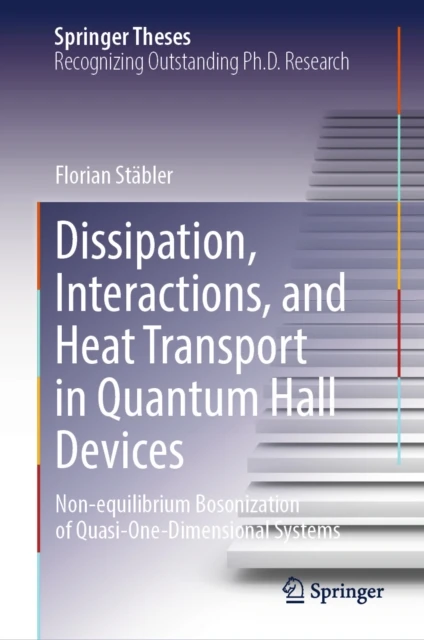
Dissipation, Interactions, and Heat Transport in Quantum Hall Devices
Non-equilibrium Bosonization of Quasi-One-Dimensional Systems

Introduction
This thesis investigates the behavior of Ohmic contacts (OCs) within quantum hall edge systems, examining their significance in quantum transport phenomena across four different projects. This work includes a review of established findings on the OC, revisiting the heat Coulomb blockade in both single and multichannel configurations.
Modeling and Dissipation
The authors suggest the OC as a model within a transmission line (TL) framework to tackle dissipation potentially stemming from microscopic disorder, addressing the “missing heat” paradox and questioning prevailing theories on energy dissipation.
Non-local Couplings and Heat Transfer
Moreover, the authors investigate the effects of non-local couplings in drift-diffusion systems, demonstrating how they circumvent equilibrium constraints in a single edge state to facilitate heat transfer through correlations caused by interactions.
Self-looping Edge States and Properties
The thesis examines OCs with self-looping edge states to analyze states similar to those in non-local TL systems, uncovering intriguing properties such as anomalous correlation functions and altered electrical and thermal response coefficients.
Heat Coulomb Blockade and Fluctuations
Using a Langevin-like method, the authors analyze the impact of the heat Coulomb blockade on heat noise power and temperature fluctuations, showing that the temperature-temperature correlation function in equilibrium takes on a universal form and uncovering non-Gaussian Full Counting Statistics in transmitted charge as a result of temperature fluctuations.
Future Directions and Significance
Lastly, this thesis sets the groundwork for future studies, offering a collection of ideas and projects for further exploration, aiming to contribute as a valuable resource for ongoing and future research in quantum transport phenomena. In a broader context, this thesis significantly enhances our comprehension of correlations and heat transport within interacting low-dimensional systems, paving the way for advancements in electronics miniaturization, precision metrology, and the realization of quantum information technologies.