$199.99
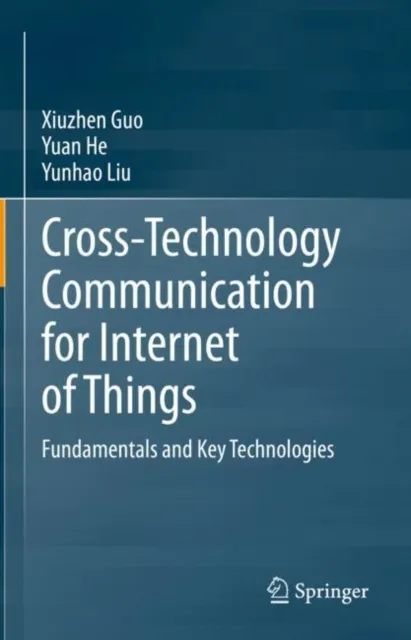
Cross-Technology Communication for Internet of Things
Fundamentals and Key Technologies

Cross-technology communication (CTC)
Cross-technology communication (CTC) is a technology that enables direct communication between heterogeneous devices that use different wireless standards. It works like a “translator” between two or more wireless technologies. CTC not only creates a new avenue for inter-operation and data exchange between wireless devices but also enhances the ability to manage wireless networks.
Focus of the Book
This book focuses on the enabling technology CTC and introduces readers to a variety of CTC techniques in heterogeneous wireless networks. These techniques can be divided into two categories: packet-level CTCs based on energy modulation and channel intervention; and physical-level CTCs based on cross-demapping, digital emulation, and split encoding. The book offers a comprehensive comparison and analysis, granting readers a deeper understanding of CTC techniques in terms of throughput, reliability, hardware modification, and concurrency. Moreover, it highlights upper-layer CTC application scenarios and cutting-edge developments, which include but are not limited to interference management, channel quality estimation, network routing, etc.
Intended Audience
The book is intended for all readers – e.g., researchers, students, and even professionals – who are interested in the areas of wireless networking, wireless communication, mobile computing, and Internet of Things. The findings and summaries presented here can help: 1) guide researchers to rethink CTC techniques in connection with design methodology; 2) further advance the infrastructure of future IoT by introducing CTC; and 3) enable important IoT applications by delivering ubiquitous network connectivity.