$59.99
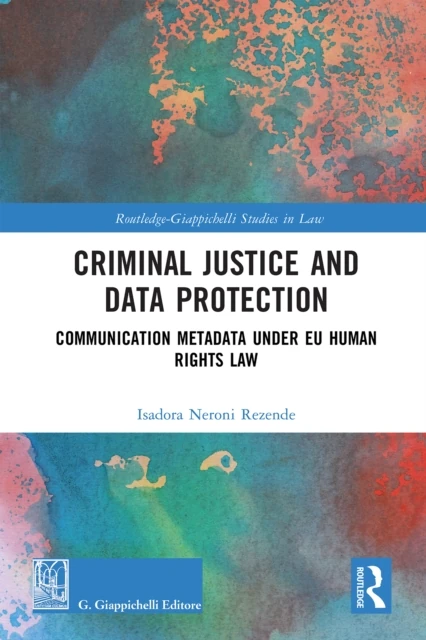
Criminal Justice and Data Protection
Communication Metadata under EU Human Rights Law

Use of Traffic and Location Data in Criminal Justice
The use of traffic and location data in criminal justice is now a common practice in the EU and beyond. Although metadata do not reveal the contents of communications, they allow to draw precise conclusions on the private lives of users, like their everyday habits, places of residence, daily movements and activities, social relationships, and frequented environments. For this reason, they are largely used by law enforcement to identify promising targets of investigation or as evidence in criminal trials.
In the EU, national legislation often provides for the indiscriminate retention of such data, but the compatibility of these mass surveillance regimes with the European human rights framework has been questioned in the case law of the European Court on Human Rights (ECtHR) and the European Court of Justice (CJEU), as well as legal scholarship. Nevertheless, the use of unlawfully retained data in criminal proceedings is not usually sanctioned in national criminal procedural systems.
Addressing the Problem
This book addresses this problem by inquiring about how communications metadata can be used in criminal proceedings, having regard to the principles of legality and fairness. In particular, through the lens of fairness, the analysis seeks to find some common ground between privacy and data protection regimes on the one hand and criminal procedural rules on the other.
To this end, it employs both an interdisciplinary doctrinal research method and a comparative analysis between a limited number of EU Member States. By identifying different standards of fairness for the preventive context, the investigation, and the trial phase, the book highlights gaps in protection and attempts to reconcile these two separate, yet closely related, regimes.