$131.99
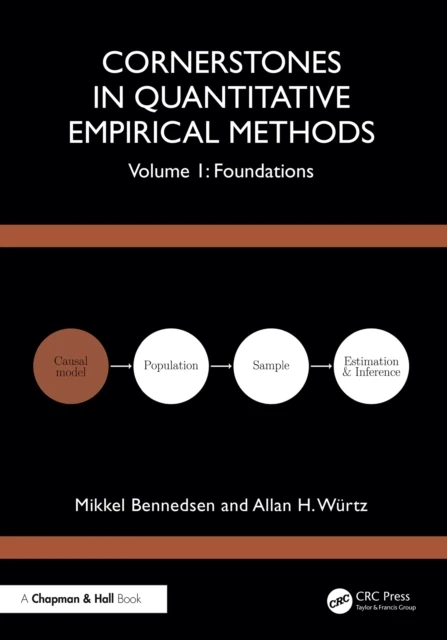
Cornerstones in Quantitative Empirical Methods
Volume 1: Foundations

Cornerstones in Quantitative Empirical Methods - Volume I: Foundations
Provides a complete, self-contained path from first principles to modern statistical inference, giving a comprehensive technical foundation for understanding and analyzing data problems using quantitative methods. The first part of the book provides a thorough introduction to probability theory and statistics with a focus on techniques and concepts, which are particularly useful for empirical analyses. Building directly on the first part, the second part of the book provides an introduction to estimation theory, hypothesis testing, likelihood theory, and Bayesian methods.
The nineteen concise chapters follow a transparent pattern: motivation and intuition, carefully chosen examples, main results stated as formal theorems, and a curated set of exercises that reinforce both computation and reasoning. Short illustrative datasets keep the exposition concrete while maintaining the book's primary focus on theory. Three appendices consolidate the required background in set theory, real analysis, and simulation techniques, making the volume fully self-contained.
Designed for graduate and advanced-undergraduate courses in e.g. economics, political science, business analytics, or data science—or for motivated self-study—Volume I equips readers with the concepts and techniques needed for quantitative empirical analysis. It also prepares readers for Volume II, which builds the foundation for modelling, prediction, and causal inference in empirical studies.
Key Features
Comprehensive coverage across the technical fields of probability theory, statistics, and mathematics, needed to understand and perform in-depth empirical modelling and analysis
Extensive treatment of estimation theory and various estimation methods, such as analog estimators, maximum likelihood estimators and Bayesian methods
Elaborate discussion of hypothesis testing and recommendations to avoid pitfalls
Inclusion of technical details and proofs structured such that they can be skipped by readers who prefer a less technical, though still cohesive, approach