$59.99
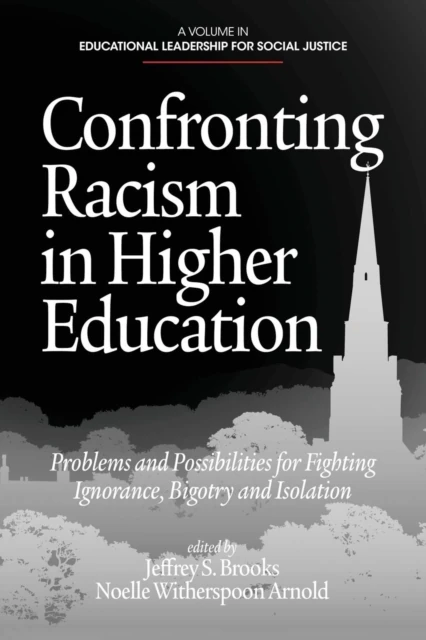
Confronting Racism in Higher Education
Problems and Possibilities for Fighting Ignorance, Bigotry and Isolation

Racism and Ignorance on College Campuses
Racism and ignorance churn on college campuses as surely as they do in society at large. Over the past fifteen years there have been many discussions regarding racism and higher education. Some of these focus on formal policies and dynamics such as Affirmative Action or The Dream Act, while many more discussions are happening in classrooms, dorm rooms and in campus communities. Of course, corollary to these conversations, some of which are generative and some of which are degenerative, is a deafening silence around how individuals and institutions can actually understand, engage and change issues related to racism in higher education. This lack of dialogue and action speaks volumes about individuals and organizations, and suggests a complicit acceptance, tolerance or even support for institutional and individual racism.
There is much work to be done if we are to improve the situation around race and race relation in institutions of higher education. There is still much work to be done in unpacking and addressing the educational realities of those who are economically, socially, and politically underserved and oppressed by implicit and overt racism. These realities manifest in ways such as lack of access to and within higher education, in equitable outcomes and in a disparity of the quality of education as a student matriculates through the system.
While there are occasional diversity and inclusion efforts made in higher education, institutions still largely address them as quotas, and not as paradigmatic changes. This focus on “counting toward equity rather than creating a culture of equity” is basically a form of white privilege that allows administrators and policymakers to show incremental “progress” and avoid more substantive action toward real equity that changes the culture(s) of institutions with longstanding racial histories that marginalize some and privilege others.
Issues in higher education are still raced from white perspectives and suffer from a view that race and racism occur in a vacuum. Some literature suggests that racism begins very early in the student experience and continues all the way to college (Berlak & Moyenda). This mis-education, mislabeling and mistreatment based on race often develops as early as five to ten years old and “follows” them to postgraduate education and beyond.