$57.99
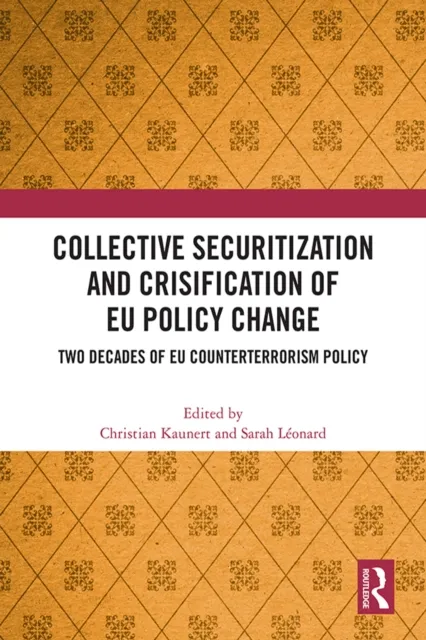
Collective Securitization and Crisification of EU Policy Change
Two Decades of EU Counterterrorism Policy

Introduction
This book represents the first attempt to evaluate the first two decades of the EU counterterrorism policy. It aims to assess the collective securitization process in EU counterterrorism, evaluating this as a process between a construction of security threats and the development of supranational governance through crisification.
Historical Context and Change
Compared to the lack of shared perception of the terrorist threat and the virtual absence of counterterrorism cooperation amongst European states in the 1970s and 1980s, the existence of EU-wide debates, legislative instruments and practical cooperation nowadays is particularly remarkable. The chapters in this volume explore this change and seek to explain it by drawing upon the concept of collective securitization. The book posits that EU counterterrorism needs to be analysed as a process driven by collective securitization as part of an ongoing process of crisification that leads to increased supranational governance.
Relevance and Timeliness
The book is both extremely relevant and timely for readers outside the area of research for several reasons. First of all, EU counterterrorism is often argued to be at the forefront of the EU’s response to new security threats. The EU acquis on the Area of Freedom, Security and Justice (AFSJ) has grown significantly over the last years. Consequently, it is crucial and very timely to examine EU counterterrorism – exactly 20 years after the first significant measures were adopted in the wake of 9/11.
Publication Note
The chapters in this book were originally published in the journal Global Affairs.