$53.99
China's Railway Transformation
History, Culture Changes and Urban Development

Introduction
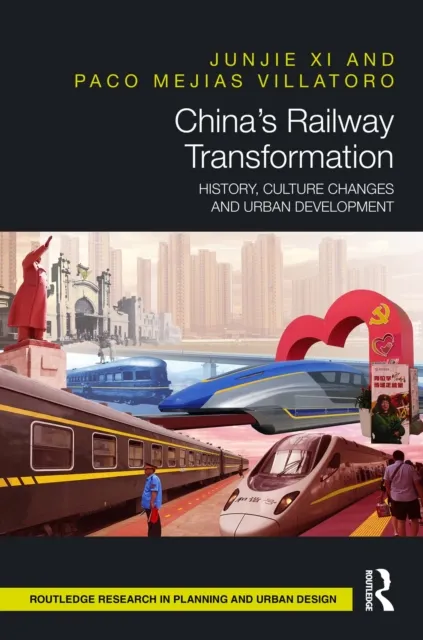
This book investigates China’s railway transformation through history, along with culture changes and urban development. The book begins by looking at the background of China and the history and growth of railway development in China through five key phases, followed by assessing the cultural changes in the railway carriage and exploring how these are linked to social equality and national provisions.
Urban Transformation and High-Speed Rail
The core of this book aims to analyse the Chinese urban transformation through the development of the high-speed rail (HSR) infrastructure in China. Eleven important new HSR stations in mainland China, plus the new Hong Kong West Kowloon Station, have been selected to contextually explore how HSR infrastructures have affected the development of the Chinese urban context. The selected case studies are the stations of Beijing South, Wuhan, Shanghai Hongqiao, Guangzhou South, Xi’an North, Nanjing South, Chengdu East, Tianjin West, Zhengzhou East, Hangzhou East and Hong Kong West Kowloon. All of these were built between 2008 and 2018. In these case studies, the location and the intentions and success of promoting urban development are analysed and assessed. Following this, the book further investigates the peculiarities of the new HSR stations in China in comparison with stations in Europe. An assessment framework is established to evaluate the Chinese case studies comparatively with significant cases in Europe, attending to the urban structure of the area, the architectural quality, the functional diversity and the quality of the public space generated in the surrounding area.