$18.49
Aristotle's De Anima
A Guide

Aristotle's De Anima
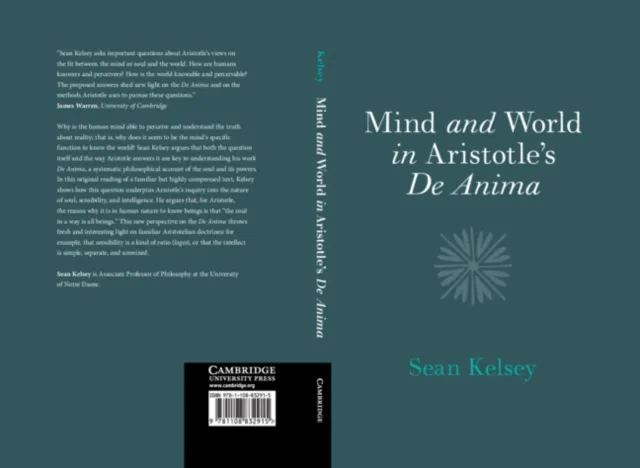
Aristotle's De Anima is an extraordinarily influential text in the history of philosophy; it is also one of the earliest works in what we now call psychology. Aristotle explores the psuchê, a distinctively Greek concept that overlaps in certain respects with our modern notions of the mind and the soul, but also applies to plants and non-human animals. The De Anima develops an innovative and challenging account of the relation between the psuchê and the body, and offers thought-provoking analyses of the different capacities of the psuchê, starting with nutrition and reproduction. A general discussion of perception is followed by detailed accounts of the five individual sense modalities, as well as perceptual imagination. After subtly exploring the intellectual capacities that he considers distinctive to human beings (where we find his famous discussion of the "agent intellect") Aristotle gives a sophisticated account of how desire leads to action.
Context and Commentary
In this lively and accessible Oxford Guide, which presupposes no knowledge of Greek, José Luis Bermúdez situates the De Anima in the context of ancient Greek philosophy, and places it within Aristotle's corpus as a whole. Each chapter is organized around focus readings from the De Anima and elsewhere in Aristotle's writings (as well as from Plato's Phaedo and Theaetetus). Bermúdez develops a historically-informed account of Aristotle's arguments in the De Anima that draws connections with contemporary philosophy of mind as appropriate. The reader is introduced to some of the key topics and controversies in modern Aristotle scholarship, as well as to the insights of the ancient and medieval commentators.