$5.29
American by Choice

The Story of American by Choice
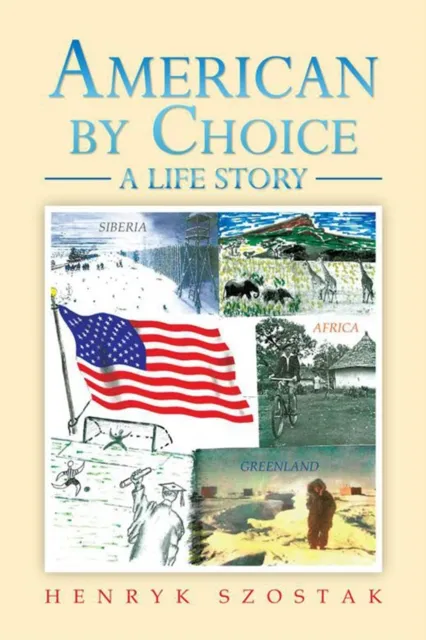
The book American by Choice is the true story of Henryk Szostak and his family's odyssey from Poland to Siberia, Africa, England, and finally, the United States of America. It chronicles how Henryk, as a seven-year-old boy in Africa, learned of the United States from an unlikely source: newspaper comics. He was highly moved by the tale of an honest black American shoeshine boy, and for fifteen years, Henryk nurtured the dream of becoming a citizen of the land of the free.
The book, written in narrative form in Henryk's own words, is an autobiography of his family's journey, but also serves as a testament to what humans can endure and overcome through sheer survival instinct, faith, and a little luck. The hardships they endured at a guarded labor camp in Siberia, and the difficulties, starvation, and suffering experienced during their passage through Russia and Uzbekistan, need to be shared with all future generations.
Family Roots and Early Life
Henryk's story begins in the area southeast of Warsaw, where his ancestors had lived for centuries on a small land estate. In addition to Henryk's Polish heritage, some Dutch ancestors entered the family tree during the 1800s. In the late 1920s, Henryk's parents moved east to Belarus territory, an area deeded to Poland by the Versailles Treaty after World War I. They bought land in the village of Dabrowa and worked hard as pioneers creating a small, thriving estate. The future looked promising for the young family of five, but everything came to a sudden halt when Hitler's Nazis invaded Poland in September 1939, marking the beginning of World War II.
The Deportation and Labor Camp
Local Belarusians rebelled against the Poles and committed ruthless massacres. Russian communists arrived in spring 1940, ending the atrocities but forcibly deporting the Szostaks and many other Eastern European families to Siberia. Their only crime was owning land, being educated, or holding leadership roles in their communities.
On the night the Szostaks were driven from their home, the Bolshevik Russians gave the family two hours to gather basic possessions but did not specify where they were being sent. Henryk's mother was pregnant, and when a Bolshevik, moved by her condition, pointed to a down quilt, she surmised the journey would be north. No money or jewelry was allowed—only basic necessities and whatever food they could gather. The family was loaded onto a horse-drawn sleigh and taken to a rail depot, then forced onto a cattle train bound for northern Russia.
During the slow, tortuous journey north, with no heat and minimal food, many succumbed to sickness and died along the way. After weeks of travel, the deportees arrived at a guarded stockade in Archangelsk, a labor camp where they endured unthinkable hardships, bitter Siberian winters, and mosquito-infested summers. Conditions were horrible—overcrowding, primitive living facilities, lack of food, and rampant disease contributed to misery and death. It was in this environment that Henryk's sister Mary was born. People simply existed, with no hope for the future.
Turning Point and Hope for Freedom
In mid-June 1942, a miraculous event occurred when Hitler's Nazis attacked Russia. Soviet Russia became allied with the West, and the exile Polish government in London negotiated a deal with Stalin to free the deportees. A major turnaround happened when the Poles offered to form an army in Uzbekistan under British command. Stalin reluctantly agreed and declared an amnesty allowing the dependents of Polish soldiers to leave the country.
Euphoria erupted among the Polish deportees throughout Siberia. Men flocked to Archangelsk from surrounding areas, as this was one of the major rallying points for their hopes of freedom.