£3.66
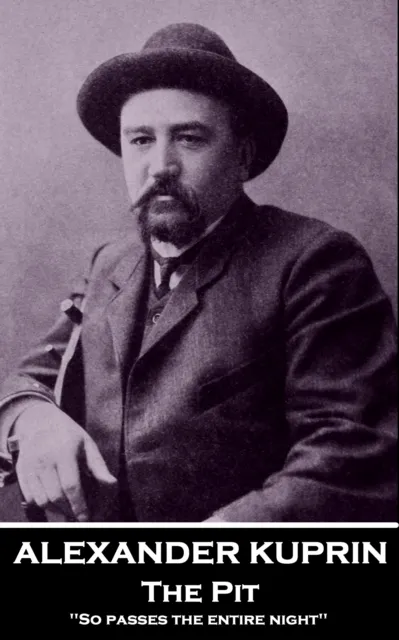
Yama (The Pit)
'So passes the entire night''

Birth and Early Life
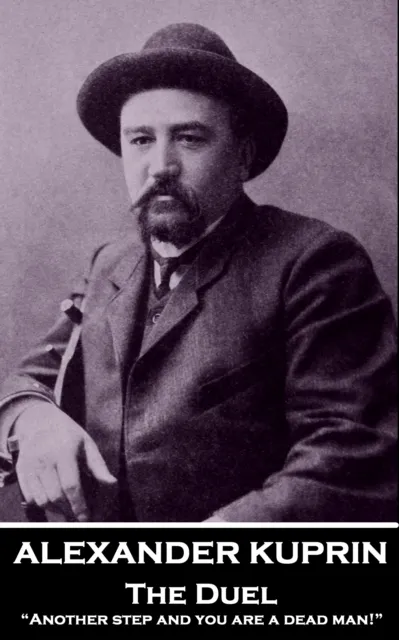
Aleksandr Kuprin was born in Narovchat, Penza in Russia on 7th September 1870.
At 3 his Father died and 3 years later he and mother moved into the Widows' Home in Kudrino, Moscow. His initial education at the Razumovsky boarding school was to cause him many childhood grievances, but he was popular amongst his peers and already a fine storyteller.
Education and Early Writing
In 1880 Kuprin enrolled at the Second Moscow Military High School and his interest in literature began in earnest along with the writing of several poems and some translations of foreign verse. In autumn, 1888 he entered the Alexander Military Academy in Moscow and graduated two years later as a sub-lieutenant and was posted to the 46th Dnieper Infantry Regiment for the next four years.
In 1889 he published his debut short story ‘The Last Debut’, based on the real life incident of the suicide by poisoning on stage of the singer Yevlalya Kadmina in 1881. Three years later came ‘Psyche’.
Military Career and Literary Beginnings
He continued writing and in 1894 resigned from the Army with the publication of ‘The Enquiry’. The appearance of this story written and signed by an officer made further time in the military difficult.
On a five-year-long trip through the South-West of the country he took up many jobs; dental care, land surveying, acting, circus performer, psalm singer, doctor, hunter, fisherman, all of these varied experiences were later used in his fiction.
Journalism and Early Publications
In summer 1894 Kuprin arrived in Kiev and began work for local newspapers Kievskoe Slovo, Zhizn i Iskusstvo, and later Kievlianin. He kept up his other contributions for newspapers further afield.
Eight of his sketches were printed in book form in March 1896. His second collection ‘Miniatures’, the following year, earned high praise from a certain Leo Tolstoy.
Major Works and Social Critique
In 1896 Moloch, Kuprin's first major work was published, a critique of the rapidly expanding Russian capitalism and a reflection of the growing social unrest in the country.
By 1901 his reputation had earned him an invitation to St Petersburg to work on a popular monthly magazine. Here he met and befriended Anton Chekhov and Ivan Bunin and joined a literary society of the emerging young realist writers including Gorky, Bunin, and Leonid Andreyev.
Marriage and Literary Development
Marriage came in February 1902 to the daughter of the editor of Mir Bozhy raising gossip of nepotism. His long hours and responsibilities working for the monthly left him little time for his own writing.
In 1904 Kuprin started working on ‘The Duel’. This novel, first conceived during his army years, and commenting on the "horror and tedium of army life," was published in May 1905. For him it was cathartic for literature, a sensation.
Political Engagement and Adventures
After the 1905 Revolution Kuprin became openly critical of the regime and put under secret police surveillance. Another brush with the law brought him a fine and ten days' house arrest.
From 1905 he put himself forward as an elector to the first State Duma for the city of Petersburg. He also made several daring adventures; an air balloon flight with Sergey Utochkin, diving in the Black Sea, and airplane trips with Ivan Zaikin.
Later Personal Life and Recognition
In 1907 he divorced his wife and married Yelizaveta Geinrikh, who, in 1908, gave birth to their daughter Ksenia.
In October 1909 Kuprin was awarded the prestigious Pushkin Prize, jointly with Bunin.
‘The Pit’ and World War I
In 1908 Kuprin started working on ‘The Pit’, his most ambitious and controversial novel. This study of prostitution appeared in parts in 1909, 1914, and 1915. Part I provoked controversy but Parts II and III only indifference and the beginning of a creative decline.
As World War I broke out, Kuprin opened a military hospital and visited towns on the Western front. He was called up in November 1914 to command an infantry company in Finland until May 1915, then discharged due to ill health.
Revolution and Exile
The October Revolution of 1918 saw his attitude to the new regime remain ambivalent. He admired Lenin as "an honest and courageous man," and believed Bolshevism was a great, pure, disinterested doctrine, but also argued it threatened Russian culture and caused suffering among peasants.
Kuprin planned a paper called Zemlia for the peasantry, which was approved by Lenin but never materialized. During the Civil War, he took his family to Finland, then to France, arriving in Paris in July 1920.
Decline and Final Years
The next seventeen years saw the decline of his talents and his struggle with alcoholism. Poverty, health issues, and emotional distress marked his later life. His wife’s efforts to support him through a book-binding shop and library failed financially.
He believed returning to the Soviet Union could help his difficulties. In May 1937, he and his family moved to Moscow. His health worsened, and he developed cancer of the oesophagus. Aleksandr Kuprin died on 25th August 1938.