£26.59
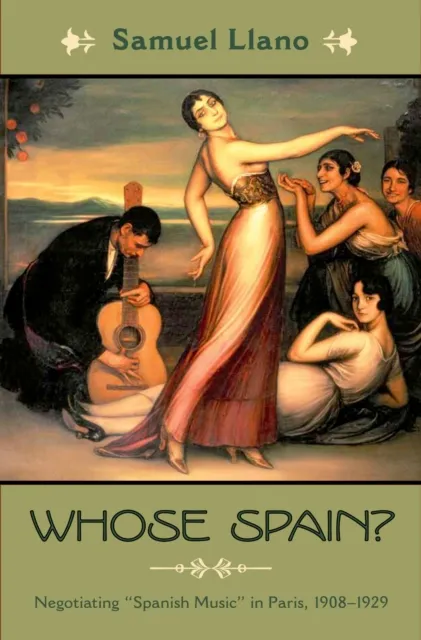
Whose Spain?
Negotiating "Spanish Music" in Paris, 1908-1929

Introduction
From the very beginning of the nineteenth century, many elements of Spanish culture carried an air of exoticism for the French—and nothing played more important of a role in shaping the French idea of Spain than the country's musical tradition. However, as Samuel Llano argues in Whose Spain?, perceptions and representations of Spanish musical identities changed in the early twentieth century, due to the emergence of the hispanistes.
The Role of the Hispanistes
These specialists on Spanish music and culture, who wrote encyclopedic and scientific articles on Spanish music, strived to endow the world of Spanish music with a sense of authority and knowledge. Yet, the writings of those hispanistes and other music critics showed a highly sensationalist attitude, aimed at describing Spanish music in a way that was instrumental to the interests of French musicians. At the same time, the Spanish fought to articulate their own identities through the creation and performance of new musical works.
Analysis of Socio-Political Discourses
In this book, Llano analyzes the socio-political discourses underpinning critical and musicological descriptions of Spanish music and the discourse's connection with French politics and culture. He also studies operas and other musical works for the stage as privileged sites for the production of Spanish musical identities, given the enhanced possibilities of performance for cultural and critical engagement.
Historical Context and Transformations
The study covers the period 1908 to 1929, when representations of Spanish music in the writings of the hispaniste Henri Collet and other French musicians underwent several transformations, mostly sparked by the need to reformulate French identity during and after the First World War. Ultimately, Llano demonstrates that definitions of French and Spanish music were to some extent interdependent, and that the public performances of these pieces even helped the musical community in France to begin to reformulate their notions of Spanish music and identity.