£54.99
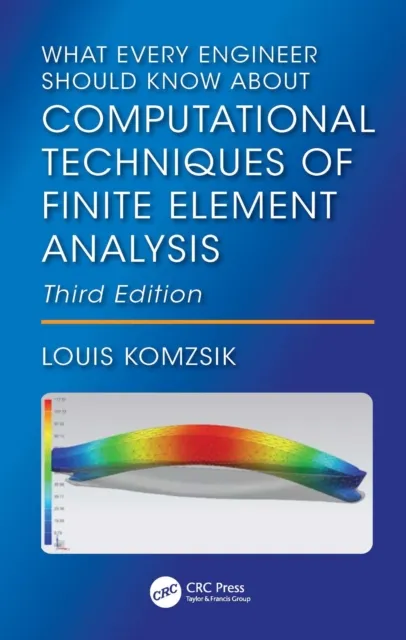
What Every Engineer Should Know About Computational Techniques of Finite Element Analysis

Overview
This book is a concise, self-contained treatment of the finite element method and all the computational techniques needed for its efficient use and practical implementation. This book describes the process of transforming the physical problem into a mathematical model, the reduction of the mathematical model to a numerically solvable computational form, and many practical engineering analysis solution techniques applied in various industries.
Publication History and Relevance
The first edition of this book was published in 2004, two decades ago. Since then, finite element analysis (FEA) has become a fundamental component of product development software tools (CAD, CAE, CAM) used in many industrial fields of engineering, particularly in mechanical and aerospace engineering. It has also become a popular text in computational science in engineering (CSE) and applied mathematics courses in academia, one of the reasons for the new edition.
New Edition Focus
This new edition presents finite element solutions to advanced industrial applications in response to readers of the earlier editions. These are heat transfer, wave propagation, topology optimization, and fluid dynamics. These topics were requested both by engineering and applied mathematics students as well as practicing mechanical and aerospace engineers. It also contains the numerical solution of a structural example to aid the teaching of finite element analysis using this textbook.