£25.00
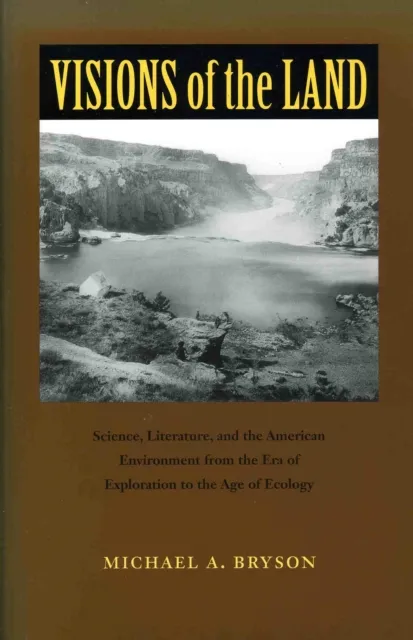
Visions of the Land
Science, Literature, and the American Environment from the Era of Exploration to the Age of Ecology

Overview of the Authors and Their Work
The work of John Charles Fremont, Richard Byrd, Charlotte Perkins Gilman, John Wesley Powell, Susan Cooper, Rachel Carson, and Loren Eiseley represents a widely divergent body of writing. Yet despite their range of genres—including exploration narratives, technical reports, natural histories, scientific autobiographies, fictional utopias, nature writing, and popular scientific literature—these seven authors produced strikingly connected representations of nature and the practice of science in America from about 1840 to 1970. Michael A. Bryson provides a thoughtful examination of the authors, their work, and the ways in which science and nature unite them.
Exploring Environmental Attitudes and Scientific Perspectives
Visions of the Land explores how our environmental attitudes have influenced and been shaped by various scientific perspectives from the time of western expansion and geographic exploration in the mid-nineteenth century to the start of the contemporary environmental movement in the twentieth century. Bryson offers a literary-critical analysis of how writers of different backgrounds, scientific training, and geographic experiences represented nature through various kinds of natural science, from natural history to cartography to resource management to ecology and evolution, and in the process, explored the possibilities and limits of science itself.
The Relationship Between Science, Nature, and Humanity
Visions of the Land examines the varied, sometimes conflicting, but always fascinating ways in which we have defined the relations among science, nature, language, and the human community. Ultimately, it is an extended meditation on the capacity of using science to live well within nature.