£28.79
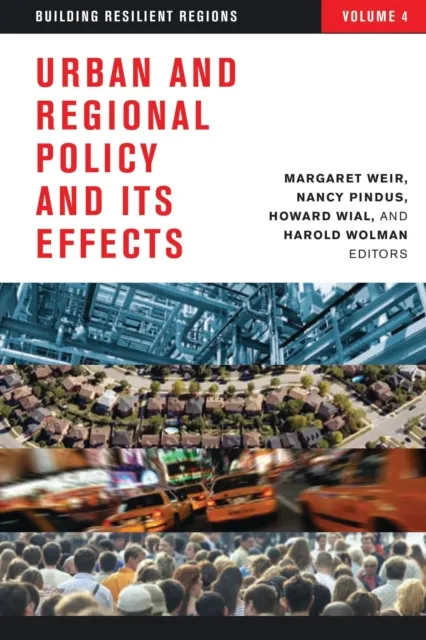
Urban and Regional Policy and its Effects
Building Resilient Regions, Volume IV

Series Mission
The mission of the Urban and Regional Policy and Its Effects series is to inform policymakers, practitioners, and scholars about the effectiveness of select policy approaches, reforms, and experiments in addressing the key social and economic problems facing today's cities, suburbs, and metropolitan areas.
Volume Four
Volume four of the series introduces and examines thoroughly the concept of regional resilience, explaining how resilience can be promotedor impededby regional characteristics and public policies.
The authors illuminate how the walls that now segment metropolitan regions across political jurisdictions and across institutionsand the gaps that separate federal laws from regional realitieshave to be bridged in order for regions to cultivate resilience.
Contributors
Patricia Atkins, George Washington University; Pamela Blumenthal, U.S. Department of Housing and Urban Development; Sarah Ficenec, George Washington University; Alec Friedhoff, Brookings Institution; Kathryn Foster, University at Buffalo, SUNY; Juliet Gainsborough, Bentley University; Edward Hill, Cleveland State University; Kate Lowe, Cornell University; John Mollenkopf, Graduate Center, City University of New York; Mai Nguyen, University of North Carolina, Chapel Hill; Manuel Pastor, University of Southern California; Rolf Pendall, Urban Institute; Nancy Pindus, Urban Institute; Sarah Reckhow, Michigan State University; Travis St. Clair, George Washington University; Todd Swanstrom, University of Missouri, St. Louis; Margaret Weir, University of California, Berkeley; Howard Wial, Brookings Institution; Harold Wolman, George Washington University