£44.99
Two Types of Compressible Isotropic Neo-Hookean Material Models

Introduction
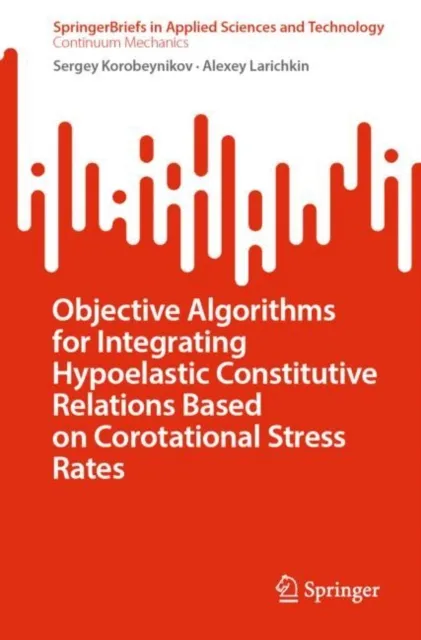
This book provides readers with a deep understanding of the principles for generating formulations of compressible isotropic hyperelastic material models based on formulations of incompressible material models.
High-Performance Incompressible Model
The reference high-performance incompressible isotropic hyperelastic material model is Ogden's model, for which the elastic energy is generally represented as the sum of elemental energies based on strain tensors from the Doyle–Ericksen family.
Elastic Energy Considerations
For transparency, the study is confined to considering the elastic energy only for one term of this sum based on the Finger strain tensor corresponding to the well-known neo-Hookean material model.
Generalizations of Neo-Hookean Models
The book presents a systematic study of the performance of two known types of compressible generalization of the incompressible neo-Hookean material model.
Volumetric-Isochoric Models
The first type of generalization is based on the development of volumetric-isochoric neo-Hookean models and involves the additive decomposition of the elastic energy into volumetric and isochoric parts.
Mixed Neo-Hookean Models
The second, simpler type of generalization, is based on the development of mixed neo-Hookean models that do not use this decomposition.
Performance and Applications
Theoretical studies of model performance and simulations of some homogeneous deformations have shown that when using “good” volumetric functions, mixed and volumetric-isochoric models show similar performance in applications and have physically reasonable responses in extreme states, which is convenient for theoretical studies.
However, compared to volumetric-isochoric models, mixed models allow the use of a wider set of volumetric functions with physically reasonable responses in extreme states. Another feature of mixed models is that they allow for simpler expressions for stresses and tangent stiffness tensors.
Target Audience
This book is useful both for novice researchers in developing hyperelastic equations for compressible materials and for experienced researchers by providing a brief overview of methods for generating compressible hyperelastic formulations based on available incompressible hyperelastic formulations.