£126.00
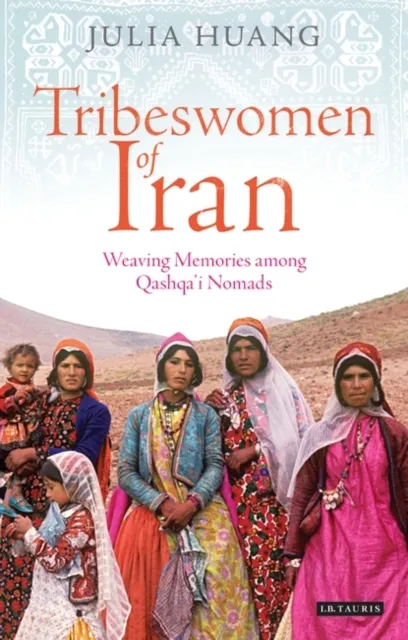
Tribeswomen of Iran
Weaving Memories among Qashqa’i Nomads

Introduction
Since the revolution in 1979, the Islamic Republic of Iran has permitted very few Western scholars to conduct research in the country. Foreign travellers and media persons have limited access and much Iranian scholarship tends to focus on the realms of politics and government. Here Julia Huang provides a remarkable account of local tribal Iranian life, offering a rare glimpse into the daily rhythms and social richness beyond the capital city of Tehran.
The Qashqa'i and the Qermezi Tribes
The Qashqa''i are a confederation of nomadic tribes, of which the Qermezi (Red Ones) are one, migrating semiannually between winter pastures near the Persian Gulf and summer pastures southwest of the city of Isfahan. Huang has visited and traveled with the Qermezi for extended periods across fourteen years. Drawing on her experiences, participation and observation, she offers an intimate window onto their life.
Focus on Women and Social Life
She focuses on a small group of women spanning four generations who are part of a large extended family, and describes their ways of life, their activities and interactions, and their distinctive sociocultural and ecological setting.
Pressures and Cultural Changes
Like other nomadic peoples around the world, the Qashqa''i increasingly face pressures that threaten their livelihoods, lifestyles and culture. Huang shows us how women negotiate compromises between customary tribal values and external influences, and sketches their efforts to resist the influences of an Islamizing, modernizing and centralizing government.
Perspectives and Identity
With shadows and resonances that rebound across the stories of these women, Huang is able to present multiple perspectives on events and contentious issues, for instance the politicized issue of women''s state-mandated modest dress. Huang also explains how the Turkic-speaking Qashqa''i relate to the wider Iranian society and the Islamic Republic of Iran, adapting to a rapidly changing world while retaining tribal values and a distinctive ethnolinguistic identity as one of Iran''s national minorities.
Life Beyond the Media
In describing life at the local level in Iran, Huang depicts a community largely beyond the scope and reach of foreign travellers and the Western media.
Conclusion
With rich ethnographic description and analysis, intimate portraits of the private lives and spaces of women and children, and diverse perspectives, this engagingly written account documents a disappearing way of life. Tribeswomen of Iran is essential reading for all those interested in Iran, the Middle East, anthropology, nomadism and gender.