£119.50
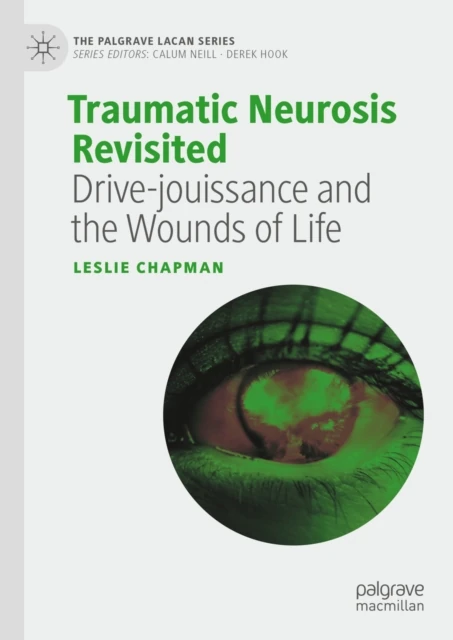
Traumatic Neurosis Revisited
Drive-jouissance and the Wounds of Life

Introduction
This book argues that Freud’s theory of the traumatic neuroses can provide a ‘conceptual bridge’ between the Lacanian idea of an ‘inaugural’ or ‘founding’ trauma that constitutes the human subject and the more popular idea that trauma is brought about by external events, for example, war or sexual violence. It proposes a new reading of Freud’s theory which draws on Lacanian concepts, including the Real, jouissance, the idea of ‘suture’, and Lacan’s ‘deconstruction’ of Freud’s drive theory. It also argues for a ‘cybernetic’ reading of Lacan’s theory of language, which he outlined in his second Seminar; and for a reappraisal of Freud’s concept of Nachträglichkeit as a way to facilitate a better understanding of the retroactive nature of trauma and its relation to language and the drive.
Challenging Assumptions
In doing so, it offers a challenge to key assumptions underpinning the dominant discourse of trauma, which is exemplified in what the author terms ‘the PTSD paradigm’. In particular it challenges the idea that trauma is something that simply ‘happens’ to human beings and that its effects that can be eradicated through the construction of various forms of trauma narrative, for example, in psychotherapy and different types of collective histories. In the development of this argument the author also draws on the work of Jean Laplanche, which has previously been under-utilised in mainstream Lacanian theory and practice.
Conclusion
This book sheds new light on the relationship between the traumatic effects of the signifier and the impact of the ‘external’ world. It will be of interest to practitioners, as well as to students and scholars of psychoanalysis and philosophy.